%20(1).png)
Guide to Clothing Size Grading Standards (2026)
- Powersweet Team

- Aug 8
- 12 min read
Updated: Aug 11
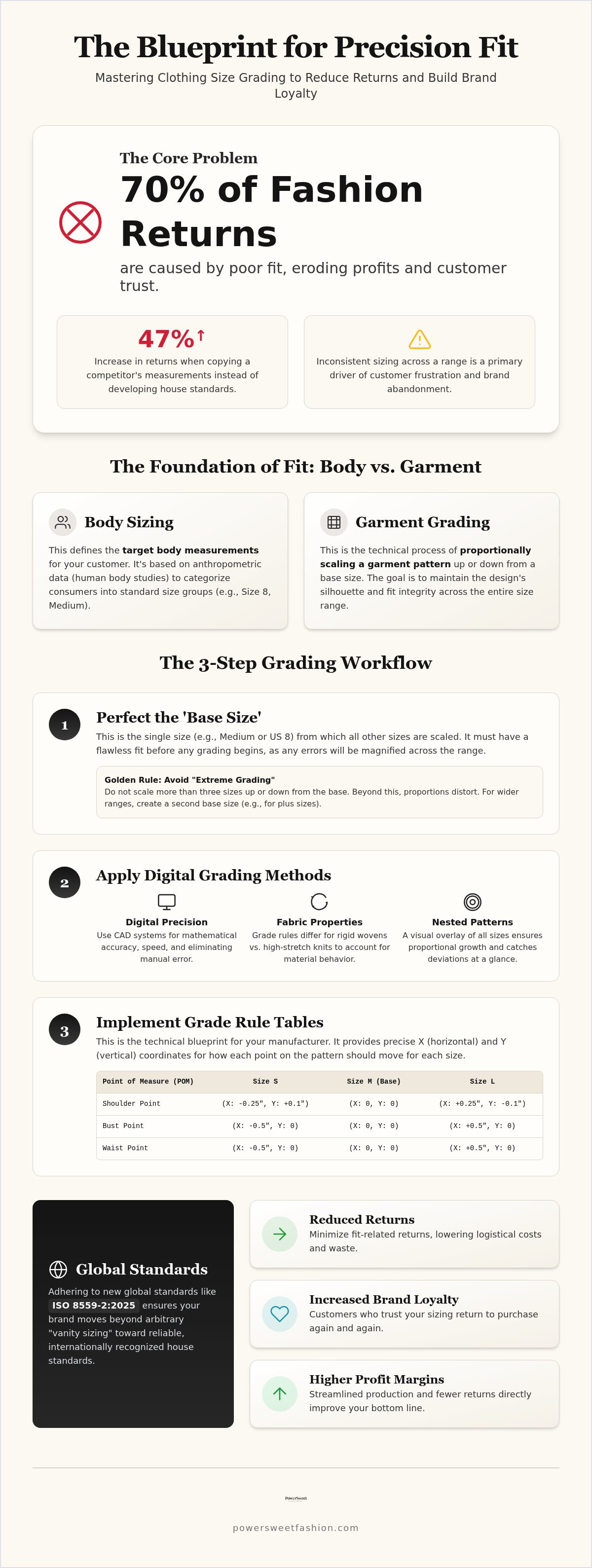
Poor fit causes 70% of all fashion returns. It's a staggering figure that directly erodes your profit margins and damages customer trust. Many brands attempt to bypass the technical work by copying a competitor's measurements, but research shows this shortcut leads to a 47% increase in return rates. You've likely experienced the frustration of a production run where the sample size is flawless, yet the rest of the range feels inconsistent. Mastering clothing size grading standards is no longer optional; it's a strategic necessity for any brand looking to scale in 2026.
We know the pressure of getting every measurement right before the fabric is cut. This guide provides a technical framework to help you create precise grade rules that maintain your design's integrity across every size. We'll explore the new ISO 8559-2:2025 global standards and the logistical shift toward digital product passports. You'll gain the tools to reduce production errors and communicate clearly with your manufacturing partners. By the end of this article, you'll have a roadmap for consistent sizing that builds genuine brand loyalty and reduces costly overhead.
Table of Contents
What are Clothing Size Grading Standards and Why Do They Matter?
Grading is the technical process of proportionally increasing or decreasing a base pattern to create a full size range. It's the bridge between a single, perfected sample and a scalable commercial collection. While many designers focus on the creative silhouette, the mechanics of clothing size grading standards determine whether that silhouette actually works for a customer in a size XS or a size XXL. Precise grading ensures that the fit remains stable, regardless of the size on the label.
There's a fundamental difference between sizing and grading. Sizing refers to the target body measurements defined by international clothing size standards, which categorize consumers into groups based on anthropometric data. Grading is the actual garment scaling that accounts for these changes in a three dimensional space. When grading is done correctly, the garment doesn't just get bigger; it grows in specific increments at the bust, waist, and hips while maintaining the original design's aesthetic integrity.
In women's fashion, consistency is the primary driver of customer loyalty. A customer who knows a size 8 fits her perfectly every time will return to your brand without hesitation. Conversely, inconsistent grading leads to high return rates and eroded profit margins. Precise grading reduces the "fit trial" period for the consumer. This directly improves your bottom line by minimizing the logistical costs of returns and restocking.
The Concept of the 'Base Size'
Most brands choose a Medium or a US size 6/8 as their base size. This starting point serves as the midpoint of the range, allowing for more accurate scaling in both directions. You must perfect the base size before any grading begins. If the initial pattern has a fit flaw, that flaw will be magnified as you scale. We recommend avoiding "extreme grading," which is the practice of scaling more than three sizes away from the base. Beyond this point, the proportions often become distorted, requiring a second base pattern to maintain fit quality and technical accuracy.
Grading vs. Alteration: Clearing the Confusion
Simply making a garment bigger isn't technical grading. Alterations are adjustments made to a finished garment for a specific individual, whereas grading is a systematic scaling of patterns for mass production. By adhering to strict clothing size grading standards, you ensure that the original design's silhouette and proportions remain identical across the entire range. Validating the base size with a professional fit model is a critical step in this process. It provides the physical proof that your math translates into a wearable garment before you commit to bulk manufacturing.
Core Methods of Pattern Grading in Modern Manufacturing
Modern manufacturing has moved far beyond the era of hand-drawn adjustments. Today, clothing size grading standards are maintained through sophisticated digital systems that prioritize speed and mathematical accuracy. This evolution allows brands to manage complex size ranges without the risk of manual error. By shifting to digital workflows, we can ensure that a size 2 and a size 16 share the same DNA, even as their physical dimensions change.
Fabric properties dictate the specific grading method chosen for a collection. For instance, a rigid woven denim requires precise, non-negotiable increments at the seams to maintain fit and comfort. Conversely, high-stretch knits might use a more condensed grading scale because the material's elasticity compensates for slight body variations. These systems often incorporate NIST body measurement data to establish a reliable baseline for various figure types. This data-driven approach prevents the "fit drift" that often occurs when brands rely on guesswork rather than empirical standards.
Digital grading also introduces the "nested pattern," which is a visual overlay of every size in the range. This tool is essential for quality control. It allows pattern makers to see the proportional growth of the garment at a glance, ensuring no single size deviates from the design intent. When you partner with a facility that offers integrated pattern making, you ensure your digital grade rules translate perfectly to the cutting table without losing the original silhouette's integrity.
The Cut and Spread Method
The cut and spread method is the most traditional form of pattern grading. It involves literally cutting the base pattern into sections and spreading them apart to add width or length. While it's a helpful exercise for boutique designers to understand the physical mechanics of fit, it's inefficient for large-scale production. The risk of losing the original pattern's balance is high when performed manually. High-volume factories have largely abandoned this approach in favor of more streamlined digital alternatives that offer better repeatability.
Pattern Shifting and CAD Grading
Pattern shifting is a more advanced technique where the pattern outline is moved a fixed distance at specific grade points to create the next size. In 2026, this is almost exclusively handled via CAD software. These programs allow for mathematically perfect increments across the X and Y axes, ensuring clothing size grading standards are met with sub-millimeter precision. Digital grading allows for instant updates. If the base size changes during the sampling phase, the software updates the entire range automatically. This level of precision is why digital grading is now the non-negotiable standard for global fashion brands.
Navigating Global Sizing Standards: ASTM, ISO, and Beyond
Standards provide the technical foundation for consistency in a global marketplace. Organizations like ASTM International, specifically the D13.55 subcommittee, and the International Organization for Standardization (ISO) offer the industry a common language for body measurements. The recently published ISO 8559-2:2025 marks a significant shift toward a global system based on clear anthropometric data rather than arbitrary national labels. This move is essential for brands that sell across borders, as it helps align production with the physical reality of diverse consumer bodies.
Many brands struggle with "vanity sizing," the practice of labeling garments with smaller sizes than their actual measurements to flatter customers. While this might offer a brief psychological boost, it creates massive confusion in e-commerce and drives up return rates. We suggest moving toward "House Standards" instead. These are clothing size grading standards tailored specifically to your target demographic's unique body shape. If your brand targets an athletic demographic, your grade rules should prioritize broader shoulder widths and narrower waist ratios than a generic ASTM chart might suggest.
Regional differences also demand a nuanced approach to scaling. US grading often requires a more generous fit through the waist and hips to accommodate local body types. In contrast, EU standards frequently favor a narrower, more tailored silhouette. Asian markets typically necessitate shorter sleeve lengths and smaller across-shoulder measurements. Defining these regional expectations before you begin production prevents the "fit drift" that can alienate international customers and lead to deadstock.
Building a Brand-Specific Measurement Chart
Finding your market's sweet spot often starts with reverse engineering. Analyze the measurement charts of your three closest competitors to understand the fit logic your customers already expect. You must define essential data points including the bust, waist, hips, and across-shoulder measurements. These core metrics form the basis of your technical specifications. Integrating these precise data points into your mastering sample development process ensures that your manufacturing partner has a clear, executable roadmap from the very first prototype.
Addressing the 'Fit Intent'
Grading rules must adapt to the specific style of the garment. An oversized hoodie requires different scaling increments than a slim-fit bodysuit to ensure the silhouette doesn't become distorted in larger sizes. Maintaining the "look" of a design as it moves into plus-sizing is a technical challenge that requires careful attention to proportion. Fit intent is the emotional experience of the garment's silhouette. It's what makes a customer feel that a piece was designed specifically for their size, rather than just being a scaled-up version of a smaller pattern.
To see how this level of technical detail manifests in a curated collection, you can discover Everyday Curves, a brand dedicated to providing well-fitted options for plus-size women.
Implementing Grade Rules in Your Tech Pack
Grade rules are the mathematical instructions that tell a factory exactly how much a pattern should grow or shrink. These aren't just general upsizing notes. They are specific X and Y coordinates applied to each point of measure. A Grade Rule Table translates your brand's vision into data that a computer-aided design (CAD) system can process. Without this table, the factory is forced to guess, which inevitably leads to production errors and inconsistent fits.
The Point of Measure (POM) guide is the anchor of your tech pack. It provides a visual and written reference for where exactly each measurement is taken. If your POM guide is vague, your clothing size grading standards will fail during execution. For example, a waist measurement must be defined by its distance from the high point of the shoulder or the side seam to ensure the factory measures the same way you do. Precision at this stage prevents the fit drift that often happens between sampling and bulk production.
Many designers overlook the grading of non-fabric components. Trims, zippers, and pocket placements must also scale. A pocket that looks perfectly proportioned on a size Small will appear tiny and misplaced on a size XL if its coordinates aren't adjusted. Similarly, zipper lengths should often increase with the garment's length to maintain ease of use. These small details are what separate professional, high-quality garments from amateur attempts that ignore the technical realities of scaling.
The Technical Specification Sheet
The spec sheet maps every size in your range, from XS to XXL, against the base size. It's the master document for your end to end clothing production partner. Beyond the measurements, you must include tolerances. Tolerances are the allowable deviations, usually plus or minus 0.5cm to 1cm, that ensure quality control during bulk production. Providing clean, actionable data here eliminates the logistical friction that delays production timelines.
Communicating with Your Pattern Maker
Providing a reference garment alongside your tech pack is the most effective way to communicate fit intent. It gives your pattern maker a physical benchmark for drape and volume. This creates a feedback loop where samples are used to refine clothing size grading standards before you commit to bulk manufacturing. Working with a specialized sample development clothing manufacturer bridges the technical gap between your creative sketches and the factory floor.
Ready to turn your designs into a perfectly graded collection? Partner with our technical team to start your pattern making journey with precision and speed.
Partnering with a Manufacturer for Precision Grading
Choosing the right manufacturing partner is the final safeguard against fit disasters. Professional manufacturers act as technical consultants, handling the complex trigonometry required for high-level pattern scaling. While a designer focuses on the aesthetic, the factory focuses on the mechanics of execution. This partnership ensures that clothing size grading standards are not just theoretical numbers on a screen but functional instructions that produce wearable garments. By shifting the technical burden to a seasoned partner, you eliminate the guesswork that often leads to inconsistent sizing and costly production errors.
Integrated production offers a distinct advantage for growing brands. When pattern making and bulk manufacturing occur within the same facility, the risk of data loss or "translation" errors is virtually zero. This end-to-end approach ensures that the digital grade rules established during sampling are the exact rules used on the cutting table. PowerSweet Fashion streamlines this transition with a 10-day sampling turnaround. This speed allows you to validate fit and grading logic in record time, giving you the confidence to move into bulk production without the typical delays associated with multiple rounds of revisions.
Quality Control in the Grading Process
Size sets are the industry's gold standard for verification. This process involves producing a physical sample of every size in your range to confirm that the grading math translates to a real-world fit. A professional custom women's clothing manufacturer uses these sets to catch subtle issues that digital software might miss, such as how a specific fabric's weight affects the drape of a size XL compared to a size XS. Factory-side pattern makers serve as your technical troubleshooters. They identify potential design flaws early, ensuring that every unit in your run maintains the same high quality as your approved sample.
Scaling Your Brand with Standardized Grading
Moving from small batches to bulk production requires a foundation of trust in your technical data. Standardized grading allows you to scale your business without reinventing your fit logic every season. It makes the re-ordering process simple because your technical specifications are already locked into the factory's system. By leveraging the flexibility of a low MOQ women's clothing manufacturer, you can test new size ranges or niche fits with minimal inventory risk. This strategic approach lets you refine your clothing size grading standards based on real-world customer feedback, ensuring your brand grows on a foundation of precision and customer loyalty.
Building Fit Consistency for Long-Term Brand Growth
Success in modern manufacturing requires a partner who understands that grading is both a science and a strategic asset. We specialize in expert pattern making and grading for women's wear, ensuring your bulk production matches your approved samples with sub-millimeter accuracy. Whether you're refining your first range or scaling to high-volume output, having a technical facilitator ensures your creative vision is never lost in translation. Start your production journey with PowerSweet Fashion-Get your samples in 10 days. We're ready to help you turn your technical specifications into a perfectly fitted reality.
Frequently Asked Questions
What is the difference between pattern sizing and pattern grading?
Pattern sizing involves establishing the target body measurements for your specific customer base. In contrast, pattern grading is the technical process of scaling a perfected base pattern to create your full size range. While sizing defines the physical dimensions of the person, grading defines how the garment's fabric panels must grow or shrink to accommodate those changes. Both are essential for a professional fit.
What is a standard size grade for women's clothing?
There isn't one universal rule, but many brands use 1-inch or 2-inch total circumference increments between sizes. For example, a common grade adds 1 inch to the bust, waist, and hips when moving from a Small to a Medium. Your choice depends entirely on your target demographic. We recommend establishing your own house clothing size grading standards to ensure consistency across different product lines.
Can I use the same grading rules for all my designs?
You shouldn't apply identical rules to every garment in your collection. A rigid denim jacket requires different scaling than a high-stretch jersey dress because fabric properties dictate how a garment moves on the body. Similarly, an oversized coat and a slim-fit blouse have different fit intents. You must adjust your grade rules for each silhouette to maintain the original design's proportions and comfort.
How much does clothing size grading usually cost?
Grading costs typically depend on the complexity of the garment and the number of sizes in your range. A basic t-shirt pattern is less expensive to grade than a fully lined evening gown with intricate seam lines. Many pattern makers charge per grade point or per size. While industry rates vary, investing in professional grading during development prevents the much higher costs of bulk production errors and returns.
Is it better to grade up from a small or grade down from a large?
It's best to grade from a middle size, usually a Medium or US 6/8, rather than starting at the extremes. This base size approach minimizes the distortion that occurs when scaling patterns too far in one direction. By starting in the middle, you only need to grade two or three sizes up and down. This maintains the technical integrity of the pattern and ensures a balanced fit.
What happens if I don't provide grading rules to my manufacturer?
If you don't provide specific rules, the factory will likely use their own default grading templates. This often leads to fit drift where the final production doesn't match your brand's unique sizing goals. Without clear instructions, you lose control over the silhouette's proportions in larger or smaller sizes. Providing documented clothing size grading standards in your tech pack is the only way to guarantee consistency.
What is vanity sizing and should my brand use it?
Vanity sizing is the practice of labeling garments with smaller size numbers than the actual measurements suggest. While some brands use this to boost customer confidence, it often leads to massive inconsistency in the market. Instead of relying on vanity labels, we suggest focusing on technical accuracy. Clear, honest measurement charts help customers find their correct fit the first time, which significantly reduces your return rates.
How do I know if my grading rules are correct before bulk production?
The most reliable method is to request a size set from your manufacturer. This involves producing physical samples of the smallest, middle, and largest sizes to test the fit on live models. Digital 3D rendering can help visualize the grade, but physical samples are essential for checking fabric drape and movement. Validating your grading rules during the sampling phase ensures that your bulk production units meet your expectations.


Comments