
How to speed up your production lead time by understanding what drives it

The biggest lead-time gains often come from reducing waits, not simply making machines run faster. To understand how to speed up your production lead time, map how long an order spends at each stage, from processing and material procurement to production and shipping. Then focus on the bottlenecks, delays, and rework that extend the total.
It’s easy to focus on production itself, but an order can lose time before work begins or while it waits between operations. Production lead time runs from the start to the completion of a production order. Manufacturing lead time can also include the steps before and after production.
This guide explains what manufacturing lead time measures, how it connects to the supply chain, and how customer, material, and production stages add up to cumulative lead time. You’ll learn how to spot the delays that matter most and identify practical ways to keep work moving smoothly.
Table of Contents
1. What Is Manufacturing Lead Time?
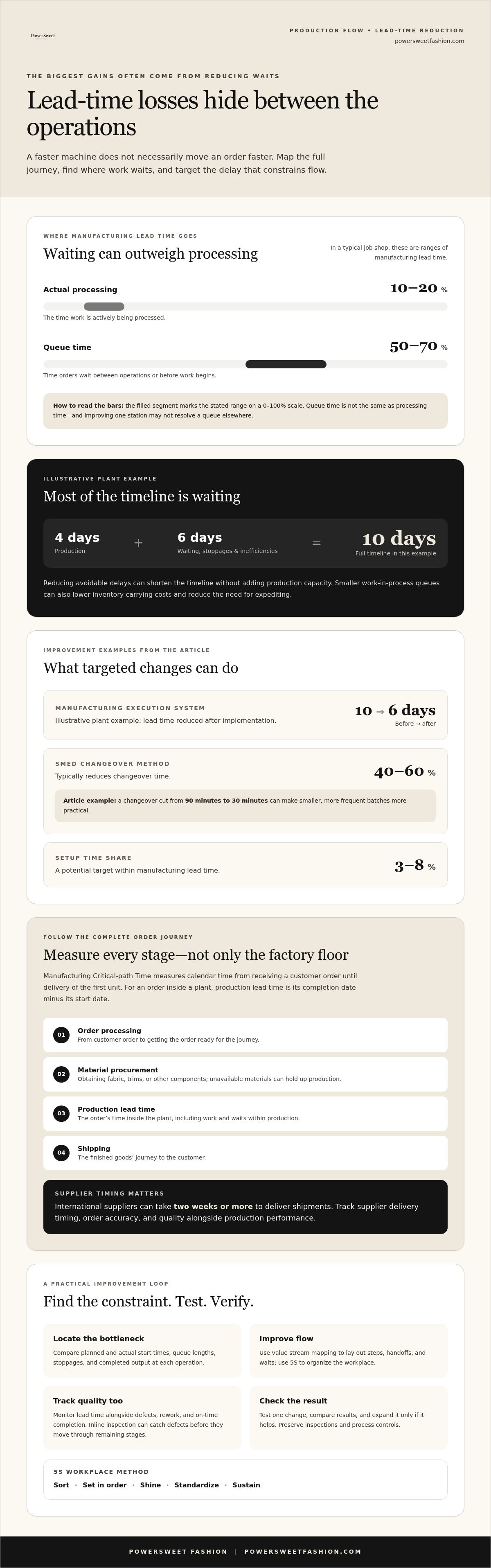
Manufacturing lead time measures how long an order takes to move through production, but the full manufacturing timeline can extend beyond the factory floor. Manufacturing Critical-path Time measures calendar time from receiving a customer order until delivering the first unit. For a production order inside a plant, production lead time is its completion date minus its start date.
To measure the full journey, add order processing, material procurement, production lead time, and shipping. Procurement covers obtaining the fabric, trims, or other components needed for production. Manufacturing lead time covers the work and waits within production, while shipping tracks the finished goods on their way to the customer. Accurate records for each stage help identify which delays are controllable.
Keep related timing metrics distinct. A cycle time measures one operation, such as a machining center completing a part in 30 minutes. Production lead time measures an order’s time inside the plant, while delivery time runs until the product reaches the customer. In a typical job shop, actual processing accounts for 10–20% of manufacturing lead time, while queue time can account for 50–70%. That gap shows why faster work at one station may not fix an order waiting elsewhere.
Lean manufacturing reduces non-value-added work by exposing delays and improving flow. Value stream mapping lays out each step, handoff, and wait, while 5S organizes the workplace through sort, set in order, shine, standardize, and sustain. In automated facilities, implementing material handling equipment from Quintec Conveyors also helps eliminate delays between workstations. Together, these methods help teams locate bottlenecks, reduce searching and avoidable movement, and keep work moving through operations.
Lead time is also a measure of manufacturing competitiveness: customers value reliable delivery, not just fast machine cycles. RenewAire achieved 140% revenue growth in five years after applying Quick Response Manufacturing principles and focusing on lead-time reduction. To assess your own performance, compare promised and actual delivery times, then trace variation back to procurement, production, or shipping. That diagnosis points to where improvements can make delivery more dependable.
2. What Is Lead Time Reduction?
Lead time reduction means removing avoidable delays between an order’s release and its completion. In an illustrative plant example, production takes 4 days, while waiting, stoppages, and inefficiencies consume 6 more. Reducing those delays can shorten the full timeline without adding production capacity. Smaller work-in-process queues can also lower inventory carrying costs and reduce the need for expediting.
Start by locating the bottleneck: the operation with the lowest capacity, which constrains the entire production system. Compare planned and actual start times, queue lengths, stoppages, and completed output at each operation. Then address the constraint directly instead of speeding up processes that already have spare capacity. This helps manufacturers remove bottlenecks without simply moving the queue elsewhere.
Prioritize changes that reduce waiting while preserving inspections and process controls. Track lead time alongside defects, rework, and on-time completion. Test one change, compare the results, and expand it only if it helps. Inline inspection can catch defects before work moves through the remaining stages, helping prevent faster production from carrying errors forward.
Digital tools can improve visibility, but their value depends on how teams use the information. In an illustrative plant example, implementing a manufacturing execution system (MES) for operational management reduced lead time from 10 days to 6 days. Across industries, shorter queues and more consistent processes can help reduce inventory and respond faster to demand, even when the actual manufacturing time stays unchanged. For instance, in specialized sectors like vitamin and supplement production, contract specialists such as vitamanufacture.co.uk rely on organized scheduling and batch management to keep lead times predictable.
Changeovers are another practical target. Setup time typically accounts for 3–8% of manufacturing lead time, and SMED methodology typically reduces changeover time by 40–60%. For example, reducing a changeover from 90 minutes to 30 minutes can make smaller, more frequent production batches more practical. That can reduce waiting between orders without sacrificing checks that protect quality.
Prioritize the delay with the greatest effect on total flow, then assess lead time and quality together. A shorter lead time is useful only if completed orders still meet specifications.
3. What is lead time in supply chain management?
Supply chain lead time covers the journey from placing an order to receiving the finished product. It connects procurement, manufacturing, and delivery, so a delay at one stage can hold up the next. For example, a factory cannot begin an order that requires fabric until the material arrives and is ready to use.
Inventory and material availability affect how soon production can start. When required components are in stock, an order can move into production sooner. If they are unavailable, the schedule depends on procurement and delivery. International suppliers can take two weeks or more to deliver shipments, so material planning matters when setting production dates. Inventory buffers can help protect against delays, but excess stock can tie up working capital.
Supplier performance determines whether planned material dates match actual arrivals. Track delivery timing, order accuracy, and quality for each supplier to identify recurring delays. Sharing demand forecasts and expected increases in demand in advance helps suppliers plan materials and capacity. Regular meetings can clarify upcoming orders and coordinate changes before they disrupt production.
Procurement strategy should balance dependable supply with flexibility. Contracts can specify lead times and penalties for delayed orders, giving both parties clear expectations. A 12-week supplier lead time, for example, can become a focus for improvement if material availability is delaying production. Discussing the forecast, order schedule, and causes of delay gives the supplier specific actions to address.
Consolidating suppliers can simplify communication because fewer partners need to coordinate each purchase. But relying on a single source can increase exposure to shortages or disruption. Diversifying the supplier base can reduce supply risks, support quality, and help meet rising demand. Choose an approach that fits the materials and production schedule rather than consolidating or adding suppliers by default.
To reduce lead time, map material waits alongside factory and shipping stages. Then compare supplier commitments with actual delivery records, share forecasts, and address the largest recurring gap first. Government regulation can also slow manufacturing, so include relevant external requirements in procurement and delivery planning. These steps help teams eliminate avoidable uncertainty across the supply chain.
4. Customer, material, production, and cumulative lead time
A customer experiences the full wait from placing an order to receiving finished goods. Break that timeline into customer, material, and production stages, then include delivery. A cumulative lead time of 20 weeks illustrates the wait when there’s no inventory and suppliers have no stock. This view shows where a delay begins, rather than just when the order arrives late.
Material lead time depends on supplier availability and replenishment timing. Production lead time depends on the product family, available capacity, and work waiting for each operation. Inventory management can shorten the customer’s wait when stock is ready, but it can also tie up resources. Monitor supplier lead time by material, production lead time by product family, lead-time variability, total customer lead time, and on-time delivery.
Scheduling and capacity planning connect demand to available production time. Takt time is the rate required to meet customer demand, calculated as available time divided by demand. To understand how to speed up your production lead time, compare this target with each operation’s actual capacity, then schedule work to match. At 90% or higher utilization, queues can grow exponentially, and lead times can double or triple.
Scheduling algorithms that account for due dates, processing times, and resource availability can reduce average lead time by 15–25% compared with simple dispatching rules. Capacity-based work release controls how much work enters the factory, helping prevent queues from overwhelming a constrained machine or team. Teams deciding how to speed up your production lead time can implement a schedule based on real capacity, then monitor waiting time and delivery performance as orders move through production.
These measures connect factory decisions to customer satisfaction: a promised date is useful only when material, production, and delivery stages support it. Compare planned dates with actual milestones to pinpoint recurring delays, then adjust the stage causing the greatest cumulative wait. For apparel production planning, map your production timeline against materials, capacity, and delivery needs before committing to order dates.
PowerSweet Fashion: Custom Women's Clothing Production
PowerSweet Fashion supports fashion brands with custom women’s clothing production, sample development, fabric sourcing, and quality control. These connected services help teams plan materials, review a garment before bulk production, and keep quality in view throughout the order process.
Turn to this support when you’re translating a design into a production-ready garment or coordinating sourcing and production stages. Samples are ready in 10 days, and bulk production takes 15–20 days. These timelines can help you plan around the stages that shape your own customer commitments, from sample review to finished garments.
Clear specifications and timely decisions help keep development and production aligned. Share your garment requirements and production goals with PowerSweet Fashion to discuss custom women’s clothing production.
Make Your Next Production Cycle More Predictable
Turn lead-time insights into a practical decision process. Choose one delay to address, assign responsibility for the change, and agree on how to assess its effect on delivery and garment quality. This keeps improvement focused on customer outcomes, not speed for its own sake. The best way to decide how to speed up your production lead time is to connect each adjustment to a clear production need and review its effect as work moves forward.
For fashion brands, planning can begin while a design is still taking shape. PowerSweet Fashion supports custom women’s clothing production, sample development, and fabric sourcing, bringing production considerations into the process early.
Contact PowerSweet Fashion to discuss production and take the next step with a clearer plan for your collection.
Frequently Asked Questions
What Is Manufacturing Lead Time?
Manufacturing lead time is the time a production order takes to pass through the factory, from its recorded start to completion. To measure it consistently, define which events mark those dates and use the same method across orders. Record pauses, rework, and completion status, too. This makes it easier to compare similar products and see whether a process change improves the actual timeline.
What Are the Main Components of Lead Time?
The main components are order handling, material procurement, production, and shipping. Within production, distinguish setup, processing, movement, and waiting. For example, a garment order may be ready for cutting but paused while a required trim arrives. Recording that pause separately from sewing time helps teams identify whether the delay lies with purchasing, a specific operation, or a handoff between stages.
What Is Delivery Lead Time?
Delivery lead time is the time between a product leaving production and reaching the customer. It includes preparing and transporting the finished order, not just factory work. Record the dispatch and receipt dates, then compare the actual arrival with the promised date. This helps separate manufacturing delays from transit or delivery delays.
What Is Lead Time Reduction?
Lead-time reduction means deliberately shortening the time needed to complete and deliver an order. It should improve flow without bypassing checks that protect product quality. For example, a team can test a revised handoff process on one product group, then review completion timing and defect records before applying the change more widely.
What impacts your lead time?
Lead time is affected by material readiness, production capacity, order changes, process interruptions, quality issues, and handoff coordination. For example, a late design approval can postpone material purchasing and push back the production schedule, even when factory operations are running smoothly. Track when decisions, materials, and work become ready to identify the dependency delaying an order.
What is lead time in supply chain management?
In supply chain management, lead time describes the elapsed journey from ordering through production and delivery to the customer. It depends on coordinated actions across suppliers, the factory, and shipping partners. For a clothing order, connect material arrival, production readiness, and dispatch milestones in one clear schedule. This helps teams spot a missed handoff before it affects the final delivery date.



Comments