
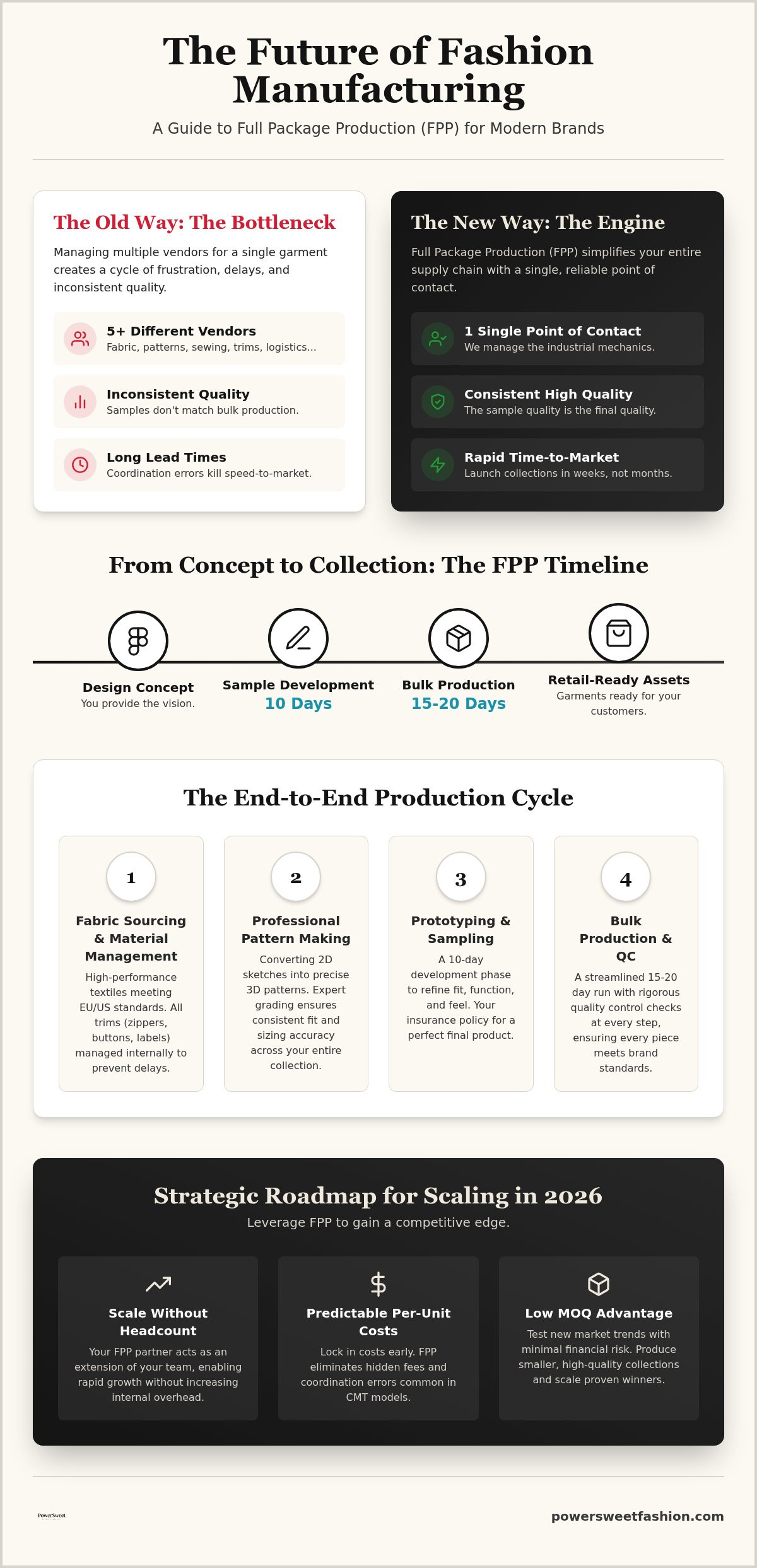
Full Package Clothing: 2026 End-to-End Manufacturing Guide

Managing five different vendors for a single garment isn't a growth strategy; it's a bottleneck that kills your 2026 collection before it hits the rack. You've likely felt the frustration of a perfect sample turning into a mediocre bulk run because your pattern maker and your factory floor weren't on the same page. It's an exhausting cycle that results in long lead times and inconsistent quality, making it nearly impossible to scale a modern women's fashion brand.
We believe manufacturing should be the engine of your brand, not its biggest hurdle. This guide demonstrates how full package production clothing simplifies your entire supply chain by providing a single, reliable point of contact for every stage of development. You'll discover how to move from concept to retail-ready assets using a 10-day sample turnaround and 15-20 day bulk production cycles. We'll preview the 2026 manufacturing landscape, covering essential shifts like Digital Product Passports and the move toward streamlined, technical partnerships that ensure your per-unit costs stay predictable while your time-to-market shrinks.
Table of Contents
What is Full Package Production (FPP) in the Garment Industry?
Full Package Production (FPP) is a comprehensive manufacturing service where a single partner manages every stage of the garment's journey. This includes sourcing raw materials, developing technical patterns, and executing the final bulk production run. Within the clothing industry, FPP acts as a streamlined engine for brands that want to bypass the logistical chaos of multi-vendor management. It's a strategic partnership. You provide the design concept; the manufacturer delivers retail-ready garments.
By 2026, the demand for agility has made FPP the standard for women's fashion labels. Designers no longer have the luxury of spending months coordinating fabric mills and sewing rooms separately. This "all-in-one" advantage reduces administrative overhead significantly. It allows your creative team to stay focused on design while we manage the industrial mechanics. We provide the infrastructure; you provide the vision.
The Difference Between FPP and CMT Models
CMT stands for "Cut, Make, Trim." In this model, the brand is responsible for sourcing and delivering all materials to the factory floor. The factory only provides the labor to assemble the pieces. While CMT might seem cheaper on paper, it often leads to hidden costs and coordination errors that delay your launch. Full package production clothing offers a more predictable financial model. Your per-unit cost is locked in early. It covers everything from the primary fabric to the final quality control checks. Risk management is another critical factor. In an FPP agreement, the manufacturer owns the supply chain. If there's a defect in the fabric sourcing or an error in pattern grading, the responsibility lies with the production partner to resolve it without additional costs to the brand.
Why Modern Fashion Brands are Moving Toward Full Package Solutions
Brands are shifting toward FPP to achieve faster speed-to-market. In 2026, the ability to move from a 10-day sample phase to a 20-day bulk production cycle is a massive competitive edge. This model supports lean inventory strategies. You can produce smaller, high-quality collections and scale up only when a trend is proven. FPP also enables rapid growth without increasing your internal headcount. You don't need to hire a full production department when your manufacturing partner functions as an extension of your team. This consistency ensures that the quality you see in the initial sample is exactly what arrives in the final shipment.
The Essential Stages of the End-to-End Clothing Production Cycle
Moving from a creative concept to a retail-ready product requires more than just a factory; it requires a disciplined industrial process. The full package production clothing model thrives on a four-stage cycle that eliminates the guesswork from your supply chain. Each stage is a checkpoint designed to protect your brand's reputation and your bottom line. By centralizing these phases, we ensure that technical details don't get lost between different vendors.
Fabric Sourcing and Material Management
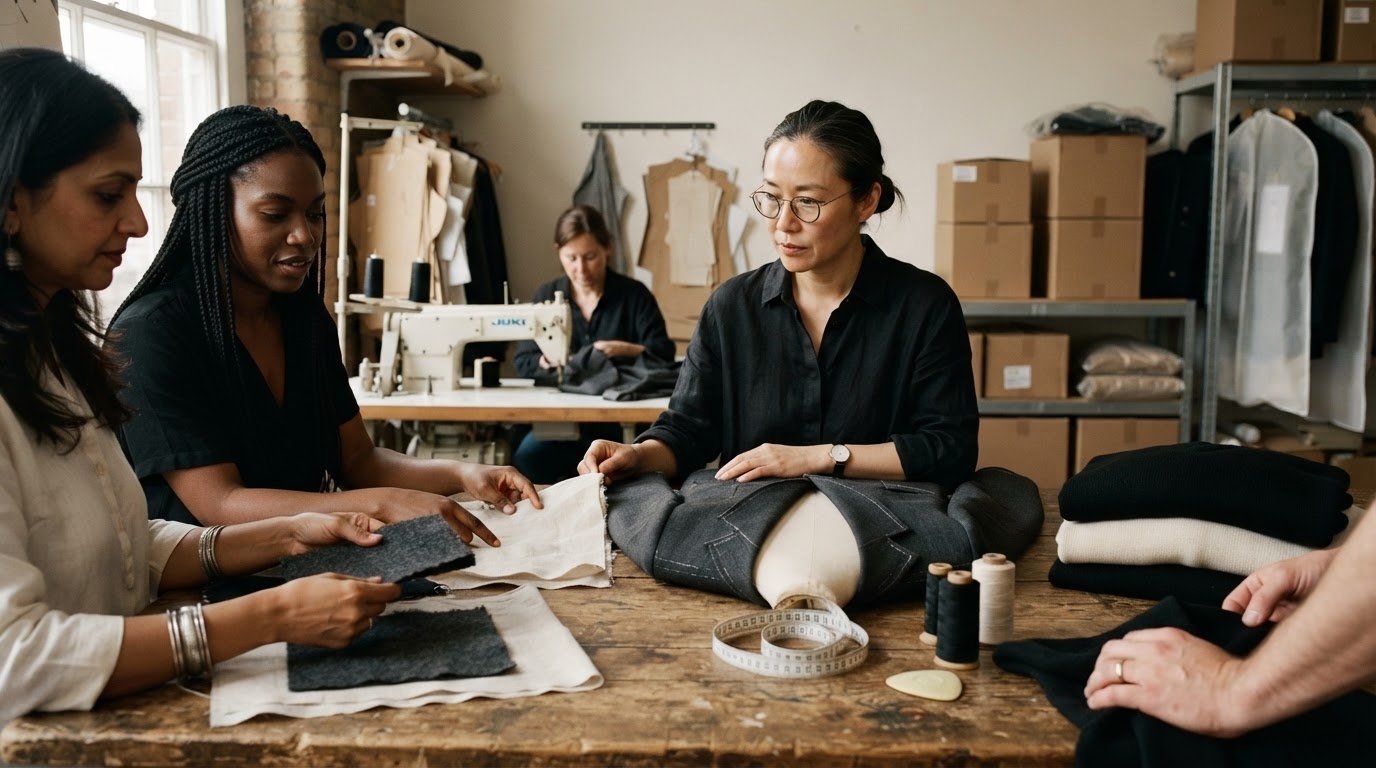
Sourcing is the foundation of quality. We use established industrial networks to find high-performance textiles that meet the rigorous EU and US sustainability standards of 2026. This process includes meticulous material management for trims like zippers, buttons, and brand-specific labels. By managing these details internally, we ensure that every component arrives at the factory floor simultaneously. This prevents the costly delays common in multi-vendor models. We focus on verifying fabric durability and colorfastness before the first cut is made, ensuring your collection stands up to retail expectations.
Professional Pattern Making and Sizing Accuracy
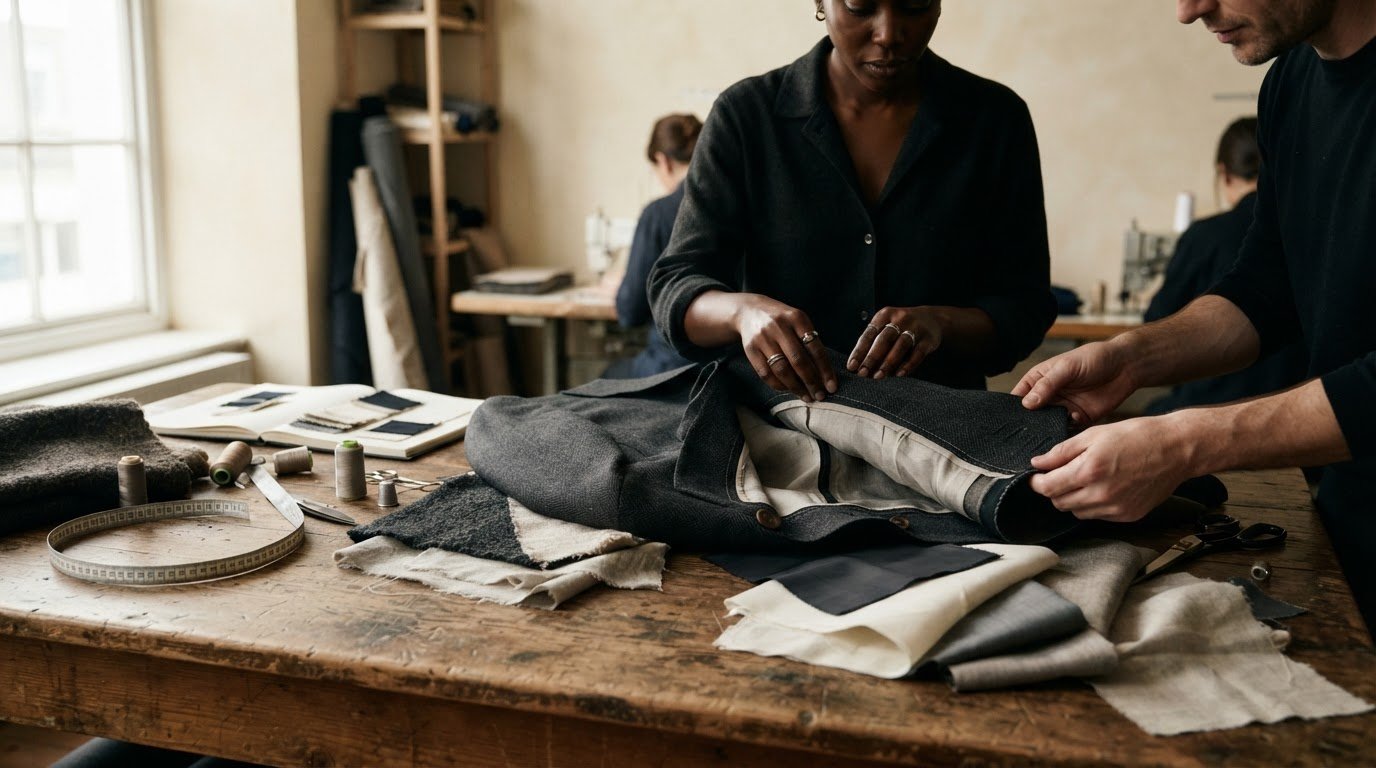
Many manufacturers overlook the technical necessity of professional pattern making, but it's the difference between a garment that sits on a shelf and one that sells out. Our team converts 2D design sketches into precise 3D patterns tailored specifically for women's fashion categories. This ensures consistent sizing across your entire collection. Expert grading is non-negotiable here; it's the key to maintaining fit integrity from a size small to an extra-large. This level of technical oversight is why industry leaders prefer full-service apparel development to ensure their brand's fit remains its strongest selling point.
Prototyping is your insurance policy. Our 10-day sample development phase allows for rapid iteration. You get a physical garment in your hands to verify the fit and fabric before committing to a larger run. This speed is a massive advantage for brands testing fast-moving 2026 trends. Once you give the green light, we transition into the 15-20 day bulk production cycle. This phase is governed by strict quality assurance protocols. We inspect every unit to ensure it mirrors the approved sample perfectly. If you're looking for a partner to handle these technical details, you can explore our sample development and sourcing services to see how we streamline the journey from sketch to store.
Bridging the Gap: From Prototype to Bulk Production
The transition from a prototype to a mass run is often where many fashion brands lose control. In the full package production clothing model, this transition is a hard-coded system rather than a series of guesses. Final sample approval serves as the definitive green light. Once you approve that physical garment, it becomes the golden standard against which every single piece in the bulk run is measured. This ensures that the fit, drape, and finish you loved in the studio are what your customers receive. We treat the approved sample as a physical contract that dictates the quality of the entire shipment.
The 15-20 Day Bulk Production Timeline
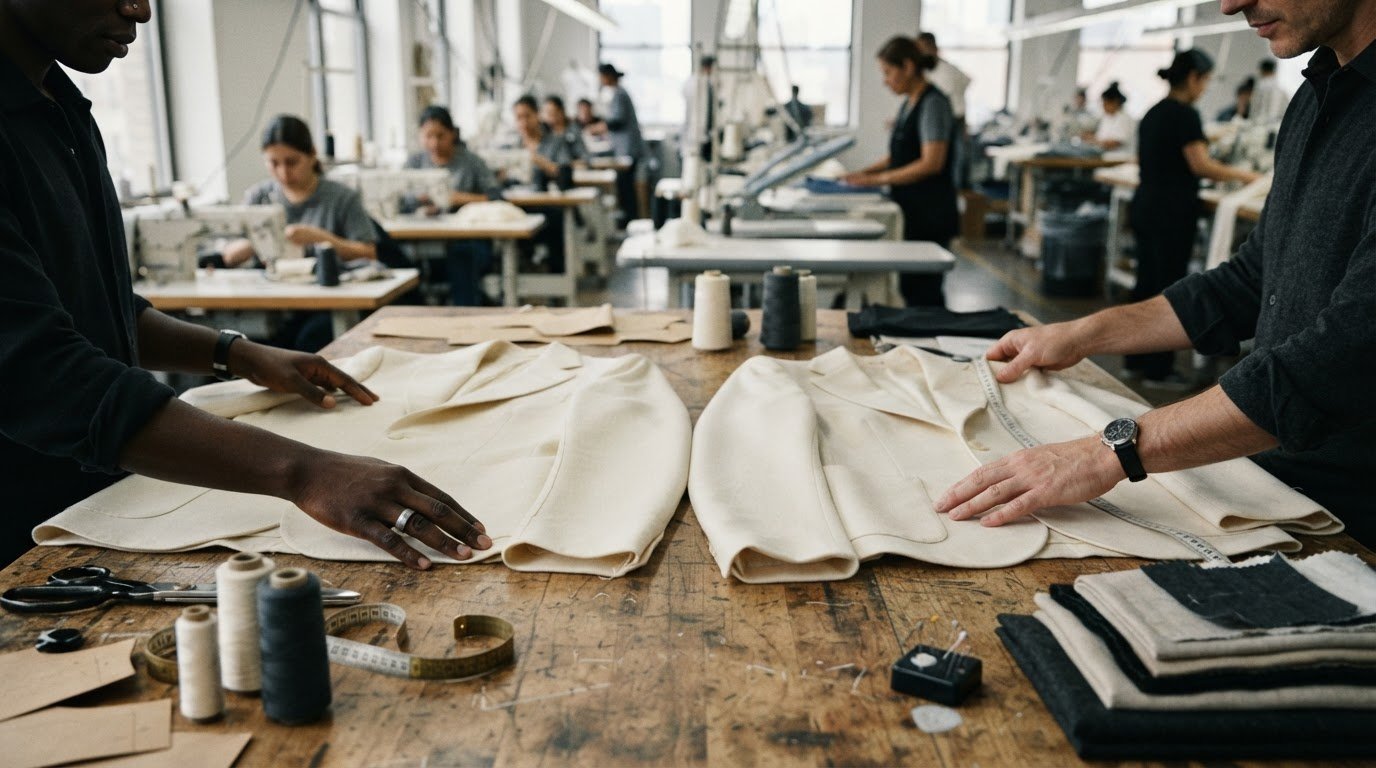
Speed is a non-negotiable requirement for 2026 fashion cycles. Our timeline is built on a 15-20 day cycle that moves with industrial precision. During the first three days, we focus on fabric spreading and precision cutting based on the digital markers created during the pattern-making phase. The middle ten days are dedicated to assembly on specialized sewing lines optimized for women's wear categories, such as structured dresses or high-performance activewear. The final week involves finishing, which includes steam pressing, trimming loose threads, and applying brand-specific packaging. This rhythm allows brands to react to market shifts in real-time. By utilizing Modern manufacturing processes, we minimize waste and maximize throughput. The logistics of moving from the sewing line to the final polybag are handled by our internal team, ensuring your collection is retail-ready the moment it arrives.
Rigorous Quality Control in Full Package Production
Quality isn't an afterthought; it's a constant. We implement a 4-point inspection system that begins with the raw fabric and continues through every stage of construction. This system evaluates defects per 100 square yards, ensuring only top-tier materials reach the cutting table. During the sewing phase, we conduct internal audits at multiple checkpoints. These audits verify that every seam and hem meets the exact tech pack specifications established during development. We also welcome external audits if your brand's compliance protocols require them. This transparency builds the trust necessary for a long-term partnership. It's about being a safe pair of hands for your creative vision.
Many brands use our low Minimum Order Quantities (MOQs) to test 2026 market trends without the risk of overstocking. You can launch a small batch of a new silhouette, analyze the sales data, and trigger a larger bulk run only when the demand is proven. This lean approach protects your cash flow and keeps your inventory fresh. We act as the engine that powers your growth, providing the scale you need exactly when you need it.
Evaluating Full Package Clothing Manufacturers for Your Brand
Choosing a partner for full package production clothing is the most critical decision your brand will make in 2026. Price is always a factor, but reliability is the currency that actually builds a label. You aren't just buying labor; you're investing in a technical partnership. Assessing a manufacturer's expertise in specific women's fashion categories is the first step. A factory that excels in heavy denim might struggle with the delicate tension required for silk blouses or structured evening wear. You need a specialist who understands the nuances of your specific niche.
Proximity is often overrated in global manufacturing. A transparent partner thousands of miles away is far more valuable than a vague vendor in your own city. Transparency means having an open door to the process. It involves seeing the factory floor, understanding the labor conditions, and meeting the production team behind the machines. We encourage factory visits because they build the trust necessary for long-term collaboration. If a physical visit isn't possible, high-definition video consultations and real-time reporting act as the next best thing.
Treat the sample development phase as a litmus test for bulk reliability. If a manufacturer can't hit a 10-day sample turnaround with precision, they'll likely miss their 20-day bulk production window when the pressure of a full run begins. The sample is a preview of their operational discipline. It shows you exactly how they handle your designs and whether they can translate your tech pack into a physical reality without constant hand-holding.
Technical Proficiency and Machinery
High-end women's apparel requires specialized equipment. Delicate fabric handling demands specific needle gauges and tension-controlled sewing machines to prevent puckering or damage. You should look for a "Safe Pair of Hands" rather than the lowest bidder. A cheap factory often lacks the advanced machinery needed for complex silhouettes or technical activewear. In 2026, technical proficiency also includes the ability to work with bio-fabricated materials or recycled textiles. These fabrics often react differently to heat and stitching; your partner must have the experience to manage these variables without compromising the final fit.
Communication and Transparency Standards
Communication protocols are the backbone of a successful production run. You should establish clear reporting lines before the first cut is made. This ensures you receive updates at every major checkpoint during the 20-day production cycle. Digital tech packs are the universal language of this collaboration. They allow for instant design iterations without derailing the entire timeline. If a change is needed, it's updated in the digital file and reflected on the factory floor immediately. This level of integration prevents the costly errors that occur when communication is fragmented. To see how our technical team manages these complex workflows, you can partner with us for custom women's clothing production and experience our transparent reporting firsthand.
Scaling Your Fashion Brand with PowerSweet Fashion
PowerSweet Fashion functions as the industrial engine for global labels, transforming creative sketches into shelf-ready collections. We provide the infrastructure needed to compete in the 2026 market, where agility is the only real defense against shifting consumer tastes. By choosing our full package production clothing model, you gain access to a system optimized for speed without sacrificing the meticulous care your brand requires. We don't just act as a factory; we act as a pragmatic partner dedicated to your brand's physical reality.
Specialized Expertise in Women's Apparel
Our facility is built specifically for the complexities of women's fashion. We specialize in categories like structured dresses, delicate blouses, and custom fashion pieces that require a high degree of technical skill. Our dedicated pattern makers ensure a perfect fit every time, bridging the gap between a digital tech pack and a physical garment that flatters the wearer. You can leverage our end to end clothing production model to scale your brand predictably, knowing that every stitch is governed by our internal quality standards.
Low MOQ flexibility is a cornerstone of our service. We offer minimum order quantities starting at 50 pieces per style, which empowers boutique brands and startups to test new 2026 trends with minimal financial risk. You don't need to commit to thousands of units to get factory-direct pricing and professional oversight. This lean approach allows you to reinvest your capital into marketing and design while we handle the heavy lifting of manufacturing. It's a system designed to help you grow without the burden of overstocking.
The PowerSweet Partnership Model
We believe in a collaborative approach. Our partnership model moves beyond the traditional vendor-client relationship to create a true joint venture. We invite you into the process, offering transparency that extends to the factory floor itself. You're encouraged to meet the production team behind your brand, ensuring that the human element of craftsmanship is never lost in the industrial scale. This open-door policy provides the reassurance that your vision is in a safe pair of hands. It's about building a relationship based on empirical reliability and shared success.
Your next collection starts with a single step. Our 10-day sample turnaround is designed to get your ideas into the physical world as quickly as possible. Once the prototype is perfected, our 15-20 day bulk production cycle ensures your brand stays ahead of the competition. Contact our technical team today to initiate your first sample run and see how a streamlined manufacturing partner can transform your business trajectory in 2026.
Building Your 2026 Collection with Industrial Precision
The shift toward full package production clothing is more than a logistical upgrade; it's a strategic move to secure your brand's future. Centralizing sourcing, pattern making, and manufacturing into a single workflow eliminates the traditional bottlenecks that stall growth. By moving away from fragmented vendor management, you reclaim your time to focus on design and market expansion. Reliability is the foundation of every successful women's fashion label.
We provide the technical engine to power your creative vision through our 10-day sample turnaround and 15-20 day bulk production cycles. Our low MOQ flexibility ensures that emerging brands can test the 2026 market without the burden of excessive inventory. We invite you to experience a partnership built on transparency and precision. Start Your Production Journey with PowerSweet Fashion today. Your brand deserves a manufacturing partner that is as ambitious as your vision.
Frequently Asked Questions
What exactly is included in a full package production service?
A full package production clothing service covers the entire lifecycle from material procurement to finished goods. This includes fabric and trim sourcing, pattern making, sample development, and bulk manufacturing. Our service also integrates rigorous quality control checks at multiple stages. By managing every technical detail, we provide a streamlined, single-point-of-contact experience that allows your brand to focus on design and marketing rather than production logistics.
How do MOQs differ for full package production versus CMT?
Our full package production clothing model offers low MOQ options starting at 50 pieces per style to help brands test 2026 market trends. While factories typically require higher minimums for FPP because they assume the risk of sourcing materials, we provide flexibility for emerging labels. In contrast, CMT (Cut, Make, Trim) requires the brand to manage all fabric and trim procurement, which often results in higher overall costs and significant logistical complexity.
Can I supply my own tech pack for full package manufacturing?
Yes, providing your own tech pack is a standard part of the process. Our technical team reviews your specifications to ensure they're compatible with our industrial machinery and production standards. If your tech pack is incomplete, our pattern makers can assist in refining the details to guarantee a perfect fit. This collaborative approach ensures that your creative vision translates accurately into a physical, retail-ready garment that meets your brand's standards.
How long is the typical lead time for a full clothing collection?
Our production timeline is optimized for speed and reliability. We offer a 10-day sample turnaround to get your prototypes finalized quickly. Once the final sample is approved, bulk production typically takes between 15 and 20 days. This accelerated cycle allows women's fashion brands to react to fast-moving trends in real-time, significantly reducing the time-to-market compared to traditional manufacturing models that often take several months to complete.
Is full package production more expensive than sourcing fabrics myself?
While the per-unit cost may appear higher, FPP often results in lower total project costs. We leverage deep industrial networks to source high-quality textiles at competitive rates that individual brands can't easily access. Additionally, FPP eliminates the hidden costs of shipping materials to the factory and the risk of coordination errors. You pay for a predictable, end-to-end service that protects your margins and simplifies your financial planning for the year.
How does a manufacturer ensure sizing consistency in women's wear?
Consistency is achieved through professional pattern making and digital grading. Our team uses technical specifications to create 3D patterns that ensure fit integrity across all sizes. We perform internal audits during the sewing phase to verify that every garment matches the approved tech pack. This meticulous attention to detail is vital for women's apparel, where fit is often the primary driver of customer satisfaction and long-term brand loyalty.
What are the benefits of low MOQ manufacturing for new fashion brands?
Low MOQs empower emerging brands to test new silhouettes without committing to excessive inventory. By producing smaller batches, you can analyze sales data and customer feedback before scaling up. This lean manufacturing strategy protects your cash flow and reduces the risk of overstocking unsold goods. It's a pragmatic way to build a presence in the 2026 fashion market while maintaining high quality and operational flexibility for your collections.
Can I visit the factory during the bulk production phase?
We encourage clients to visit our facility to see the production process firsthand. Transparency is a core value of our partnership model, and meeting the team behind your brand builds long-term trust. If a physical visit isn't possible, we provide real-time updates and digital reporting throughout the cycle. Seeing the physical reality of the factory floor provides reassurance that your collection is being handled with meticulous care and industrial precision.
Comments