
Common Clothing Manufacturing Defects: A Professional Guide to Quality Control in 2026

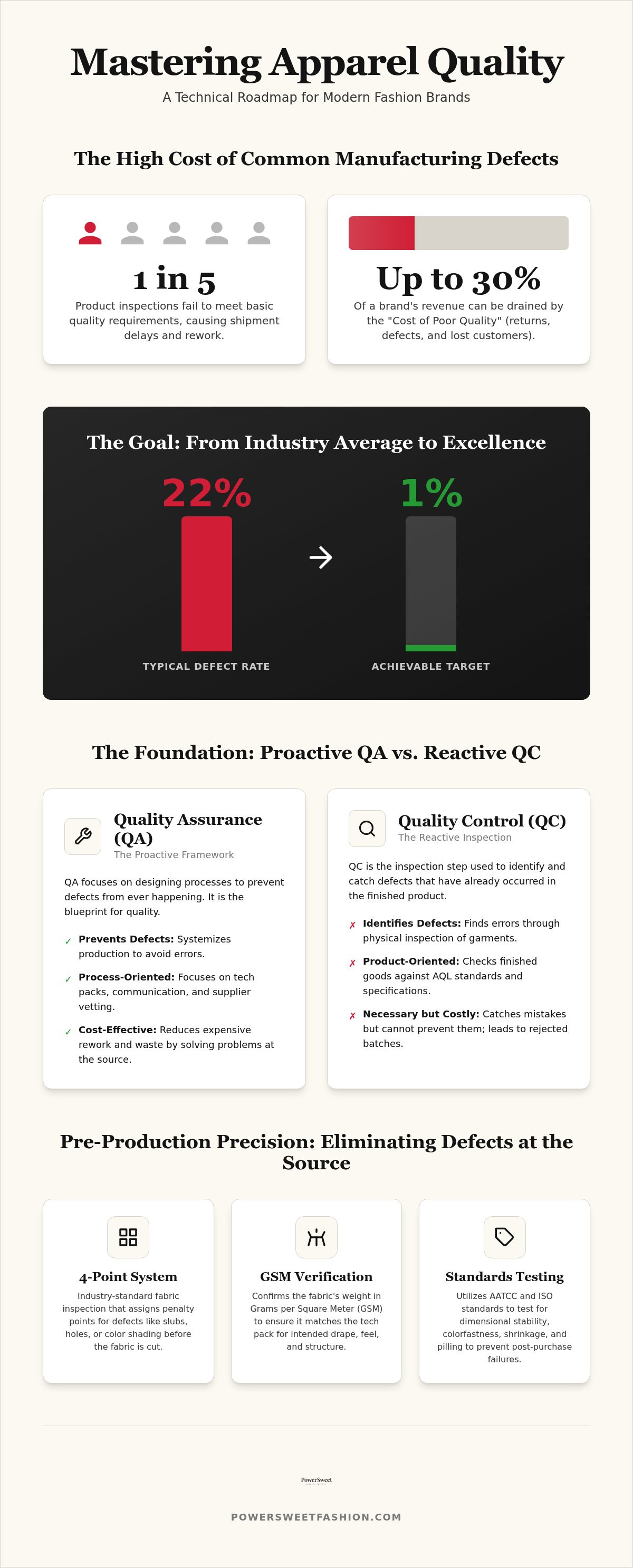
Approximately 1 in 5 product inspections in the clothing industry fails to meet basic quality requirements. For a growing fashion brand, these common clothing manufacturing defects are more than just a minor inconvenience; they represent a cost of poor quality that can drain up to 30% of your revenue. You likely know the frustration of opening a bulk shipment only to find sizing inconsistencies or fabric that looks nothing like your approved sample. It's a significant barrier to scaling, especially when overseas production feels like a black box.
This guide provides the technical roadmap you need to regain control and deliver world-class apparel. We'll break down the latest ISO 2859-1:2026 standards and explain how to apply Acceptable Quality Limits (AQL) to your production runs. You'll get a systematic checklist for quality assurance and the insights needed to reduce defect rates from 22% down to a manageable 1%. By mastering these metrics, you can choose a production partner with confidence and ensure your creative vision is executed with industrial precision.
Table of Contents
Defining Garment Manufacturing Quality: QA vs. QC
Quality isn't an accident; it's the result of a deliberate system. Many brands confuse Quality Assurance (QA) with Quality Control (QC), but they serve different functions in the factory. QA is your proactive framework. It focuses on the processes used to create the garment, ensuring that every step from pattern making to final stitching is designed to prevent common clothing manufacturing defects. QC is the reactive side. It's the physical inspection of the finished or semi-finished product to identify errors that have already occurred.
For digital-first fashion brands, this distinction is critical. You don't have the luxury of a physical dressing room to mitigate fit issues or material disappointments. Your first sale must be perfect to secure customer loyalty. Poor manufacturing quality doesn't just lead to a one-time return; it destroys customer lifetime value and erodes your brand's authority. By prioritizing first-sale perfection, you transform your supply chain from a cost center into a competitive advantage.
The Core Pillars of Apparel Quality Assurance
A robust QA system starts long before the sewing machines turn on. It begins with a comprehensive tech pack. This document acts as the technical "source of truth," standardizing every measurement, seam type, and trim requirement. Without this precision, factories are left to guess, which is a primary cause of sizing inconsistencies and structural failures. Clear technical specifications remove the ambiguity that leads to mass-production errors.
Communication protocols are the next pillar. Establishing a direct line between the design team and the production floor ensures that technical nuances aren't lost in translation. This transparency is often reinforced through supplier audits and rigorous Fabric inspection. By grading materials before they are cut, we can eliminate flaws at the source. This prevents expensive bulk errors and ensures that the final product matches the approved sample in weight, drape, and durability.
Why Quality is Your Best Marketing Strategy
In the ecommerce world, the "uncertainty gap" is the biggest hurdle to conversion. Shoppers worry about whether the fabric will feel cheap or if the fit will match the digital imagery. Consistent quality closes this gap. When a customer knows your garments will arrive without common clothing manufacturing defects, their trust in your brand scales. This reliability turns a cautious buyer into a vocal advocate, reducing your reliance on expensive customer acquisition.
Investing in premium production standards offers a significant long-term ROI. While the initial setup for high-level QA might seem intensive, it drastically reduces the financial drain of returns and rework. Reliable quality builds a foundation of brand authority that no amount of ad spend can replicate. It provides the stability needed to scale, ensuring that as your order volume grows, your reputation for excellence remains intact.
Pre-Production Precision: Eliminating Defects at the Source
Quality control isn't a final hurdle; it's a front-loaded engineering process. Many common clothing manufacturing defects originate in the fabric warehouse long before a single pattern piece is cut. To mitigate these risks, we utilize the 4-Point System, the industry standard for objective fabric evaluation. This method assigns penalty points based on the size and severity of defects like slubs, holes, or color shading. By catching these issues early, you prevent a domino effect that could compromise an entire production run.
Consistency in material weight is equally vital. We perform rigorous GSM (grams per square meter) verification to ensure the fabric matches your technical specifications. Even a slight deviation in weight can drastically alter how a garment drapes on the body. To ensure durability, we adhere to AATCC testing standards for colorfastness and shrinkage. These tests confirm that your designs won't bleed in the wash or lose their shape after the first wear, protecting your brand from post-purchase disasters.
Strategic Fabric Sourcing and Inspection
Achieving a world-class finish requires access to a specialized supply chain. Our approach to end-to-end clothing production involves vetting suppliers for more than just aesthetics. We test for pilling, abrasion resistance, and strict chemical compliance to ensure safety and longevity. When your materials are engineered for performance, the likelihood of encountering common clothing manufacturing defects during assembly drops significantly. This meticulous material vetting ensures that the physical reality of your collection matches your initial design intent.
The Power of the 10-Day Sample Gate
The Pre-Production (PP) sample serves as your "Golden Sample." It's the final blueprint for bulk production. By working with a sample development clothing manufacturer that offers a 10-day turnaround, you can identify construction flaws in real-time. This rapid prototyping phase allows us to refine pattern making and ensure accurate sizing across all tiers. It's much easier to adjust a digital pattern than to fix a thousand miscut garments. If you're ready to see your designs come to life with this level of precision, exploring our custom women's clothing production services is the first step toward a flawless collection.
Production Integrity: Identifying Common Manufacturing Defects
Production is the phase where theoretical designs face the physical constraints of industrial machinery. It's also the stage where common clothing manufacturing defects are most likely to multiply if not monitored in real-time. We implement a rigorous in-line QC system that identifies issues like improper stitch tension or seam puckering as they happen. This prevents a single machine calibration error from ruining a whole batch of garments before the mistake is caught.
Managing delicate fabrics like Lyocell or Crepe requires a specialized approach. These materials are prone to snagging or shifting under high-speed sewing needles. Our teams use specific needle gauges and thread types tailored to the fabric's weight to maintain structural integrity. By catching these technical mismatches during the first few units of a run, we ensure the bulk production remains consistent with your approved sample.
Cutting Room Controls and Pattern Accuracy
Precision begins on the cutting table. Before any blade touches the material, we prioritize fabric relaxation. Delicate fabrics are often wound tightly on rolls; if cut immediately, they'll snap back and cause significant sizing discrepancies. We allow these materials to rest for at least 24 hours to ensure dimensional stability. This step is vital for preventing the "creeping" effect that leads to uneven hemlines.
We use digital markers to maximize fabric yield while maintaining perfect symmetry. This digital precision prevents grainline shifts, which are a major cause of garments twisting on the body after washing. Once cut, we audit individual panels for frayed edges or missing notches. These small details ensure that the sewing team can align pieces perfectly, maintaining the integrity of the original pattern across every size in your range.
Sewing Standards for Premium Women’s Wear
The transition from a cut panel to a finished garment requires technical mastery of stitch metrics. For premium women's wear, Stitches Per Inch (SPI) is a non-negotiable quality indicator. While budget production might use 8 to 10 SPI, we maintain 12 to 14 SPI to provide the durability and refined finish expected in luxury markets. Higher stitch counts create stronger seams that can withstand the stresses of daily wear without popping or fraying.
Critical seam analysis is part of our daily routine. We reinforce high-stress points like armholes and side vents to prevent structural failure. Handling complex embellishments or intricate drapes requires a custom women’s clothing manufacturer with specialized experience in delicate construction. Our end-of-line inspection serves as the final gate, where every garment is checked for loose threads, symmetrical collars, and functional hardware. This methodical approach ensures that your brand’s reputation remains as solid as the seams we sew.
The Technical Metrics of Garment Quality Evaluation
Technical evaluation is the objective filter that separates professional production from a chaotic manufacturing run. To manage common clothing manufacturing defects at scale, brands must move beyond visual checks and start measuring against empirical standards. We rely on the ISO 2859-1:2026 international standard for acceptance sampling. This system provides a mathematical framework to determine if a batch meets your quality threshold without needing to inspect every single unit, ensuring efficiency without sacrificing reliability.
The core of this evaluation is the Acceptable Quality Limit (AQL). For most women's wear, the industry standard is an AQL of 2.5 for major defects and 4.0 for minor defects. If you're working with a new factory, we recommend a stricter AQL of 1.5 for major defects to establish a high baseline of trust. By identifying common clothing manufacturing defects through statistical sampling, you can make informed decisions about your inventory. Beyond sampling, we measure dimensional stability by comparing finished garments against your original tech pack. Even a 2% deviation in a waist measurement can lead to high return rates and customer dissatisfaction.
How to Read an Inspection Report
A professional inspection report categorizes errors into three distinct tiers. Critical defects (AQL 0) are non-negotiable safety or legal violations, such as a broken needle left in a seam. Major defects (AQL 2.5) are issues that a customer will notice and likely cause a return, such as a visible stain or incorrect sizing. Minor defects (AQL 4.0) are small cosmetic issues that don't affect the garment's function, like a slightly long thread end. Understanding these categories allows you to make data-driven decisions on whether to approve a shipment or request a re-work before the goods leave the factory.
Finishing and Packaging Standards
The final stage of quality control happens in the finishing room. This is where we perform the "Pull Test" on buttons and zippers to ensure they meet safety compliance and durability standards. Every garment undergoes professional steam pressing and meticulous thread trimming to provide that retail-ready finish. Safety is paramount; we utilize metal detection systems to ensure no broken needles or metallic fragments remain in the fabric. This is a critical step for protecting both your customers and your brand reputation.
Packaging integrity is your final defense against environmental damage during transit. We use specific folding techniques and moisture-resistant packaging to prevent mildew or crushing while the shipment is in the supply chain. If you're looking for a partner that prioritizes this level of technical oversight, our quality control services ensure your collection arrives in pristine condition. This methodical approach to finishing ensures that the quality engineered during production is preserved until it reaches your customer's door.
Scaling Quality: The PowerSweet Fashion Partner Approach
Quality isn't a final destination; it's a collaborative journey. While technical metrics provide the "what," the partnership model provides the "how." We bridge the gap between your creative vision and the physical reality of the factory floor by treating production as a joint venture. This alignment is what prevents common clothing manufacturing defects from reaching your customers. By integrating design intent with manufacturing capability, we ensure the final product doesn't just look like the tech pack; it performs like it too.
Operating as a low MOQ women’s clothing manufacturer allows us to maintain a level of oversight that larger mass-production facilities often lose. Smaller batches mean our QC teams can dedicate more time to each garment, catching nuances in fabric behavior or stitch precision that might be overlooked in a high-volume rush. Our 15-20 day bulk production cycle is engineered for speed, but it's built on a foundation of stable, repeatable processes. This balance allows your brand to respond to market trends without the risk of compromising your quality standards.
Human-Centric Manufacturing
We believe that transparency is the ultimate quality assurance tool. We invite our clients into the process, allowing for in-person factory visits to meet the production team behind the brand. This "open-door" approach demystifies the manufacturing world and builds a foundation of trust that digital communication alone can't replicate. When designers and pattern makers engage in collaborative problem-solving, the result is a more refined product that avoids common clothing manufacturing defects before they ever leave the cutting room.
Empowering our workers is a core part of our philosophy. Every person on the assembly line is trained to act as the first line of defense. By fostering a culture where a machinist feels confident stopping a run to address a tension issue, we catch errors before they become bulk disasters. This human-centric focus ensures that meticulous care is woven into every seam, providing the stability you need to scale with confidence.
Future-Proofing Your Supply Chain
Quality should improve with every production run. We leverage data from previous batches to identify patterns and refine our technical specifications. This feedback loop allows us to scale from initial small batches to larger bulk orders while maintaining consistent results. As your brand grows, our systems adapt to ensure your reputation for excellence remains a constant. We don't just manufacture; we engineer a reliable supply chain that evolves with your brand's complexity.
If you're ready to move beyond the uncertainty of traditional manufacturing, it's time for a more transparent approach. Partner with PowerSweet Fashion for your next collection and experience a production process where precision, speed, and partnership converge. We act as the industrial engine that powers your creative vision, ensuring every delivery meets world-class standards.
Mastering Quality for Long-Term Brand Scale
Building a world-class apparel brand requires shifting from simple inspection to a comprehensive engineering approach. You must distinguish between proactive Quality Assurance and reactive Quality Control to protect your revenue from the high costs of returns. Mastering technical metrics like AQL ensures that common clothing manufacturing defects are identified and mitigated before they ever reach your warehouse. This systematic precision is what allows a fashion label to scale without sacrificing its reputation.
We provide the industrial engine to power your creative vision. Our specialised women’s wear expertise and 10-day sample turnaround act as a critical gate for quality; meanwhile, our transparent model allows for direct factory oversight. We invite you to step into the process and see how meticulous care transforms your designs into premium physical reality. It's time to build your collection on a foundation of reliability and trust.
Start Your Quality-Driven Production with PowerSweet Fashion and secure the stability your brand needs to thrive.
Frequently Asked Questions
What is the difference between quality assurance and quality control in fashion?
Quality Assurance (QA) is a proactive process focused on the manufacturing framework and process design to prevent errors before they occur. Quality Control (QC) is a reactive process that involves inspecting the physical product to identify existing flaws. Effective QA includes standardizing tech packs and auditing suppliers. QC acts as the final gate, using statistical sampling to verify that the bulk run meets your specific quality standards.
How do I ensure my custom designs match the quality of the samples?
The Pre-Production (PP) sample acts as your "Golden Sample" to set the technical benchmark for the bulk run. Every unit in production should be measured against this approved prototype's measurements and finish. Consistent results are achieved by maintaining strict technical specifications in your tech pack and ensuring the factory uses the same machinery and operators for both the sampling and bulk production phases.
What is the industry standard for acceptable quality limits (AQL)?
The current international standard is ISO 2859-1:2026, which defines the statistical sampling plan for inspections. For most apparel, an AQL of 2.5 for major defects and 4.0 for minor defects is the industry norm. Major defects are those likely to result in a customer return, while minor defects are small cosmetic issues. For initial orders with a new partner, many brands adopt a stricter 1.5 AQL for major defects.
How does a low MOQ manufacturer maintain high production standards?
Low MOQ models facilitate higher production standards by allowing for more granular, unit-by-unit oversight. Unlike mass-production facilities where errors can multiply rapidly across thousands of units, smaller batches enable QC teams to identify and correct issues in real-time. This focused approach ensures that every garment receives meticulous care, providing the same level of precision found in luxury boutiques while maintaining a responsive, agile supply chain for your brand.
What are the most common quality defects in women’s clothing manufacturing?
Common clothing manufacturing defects in women's wear often include sizing inconsistencies, grainline shifts that cause twisting, and poor stitch tension on delicate fabrics like silk or Lyocell. You might also encounter uneven hemlines or misaligned patterns at the seams. Identifying these early through in-line inspections and final AQL checks is critical to reducing return rates and maintaining the structural integrity required for premium fashion collections.
Can I visit the factory to oversee the quality control process?
Yes, we prioritize transparency and encourage clients to visit our production facilities in person. Meeting the production team and overseeing the quality control process firsthand bridges the gap between digital communication and physical reality. These visits allow you to verify our technical standards, observe the 4-Point System in action, and build a collaborative partnership that ensures your design vision is executed with industrial precision and care.
How long does it take to develop a high-quality garment sample?
We provide a 10-day sample turnaround to ensure your brand can move from concept to physical prototype quickly. This rapid development phase includes pattern making and specialized material sourcing tailored to your design intent. Delivering high-quality samples in this timeframe allows you to identify construction flaws early, refine your technical specifications, and proceed to bulk production with the confidence that your "Golden Sample" is perfect.
Why is fabric sourcing considered a part of the quality process?
Quality begins with the raw materials, as the fabric's weight, drape, and durability dictate the final garment's performance. Our sourcing process includes GSM verification and colorfastness testing to ensure consistency across the entire production run. By utilizing specialized sourcing for women's fashion textiles, we prevent material-related defects like pilling or excessive shrinkage, ensuring the physical reality of the garment aligns perfectly with your original technical specifications.


Comments