%20(1).png)
Clothing Manufacturer for Startups: The 2026 Trend Analysis & Founder’s Guide
- Powersweet Team

- Jul 11
- 11 min read
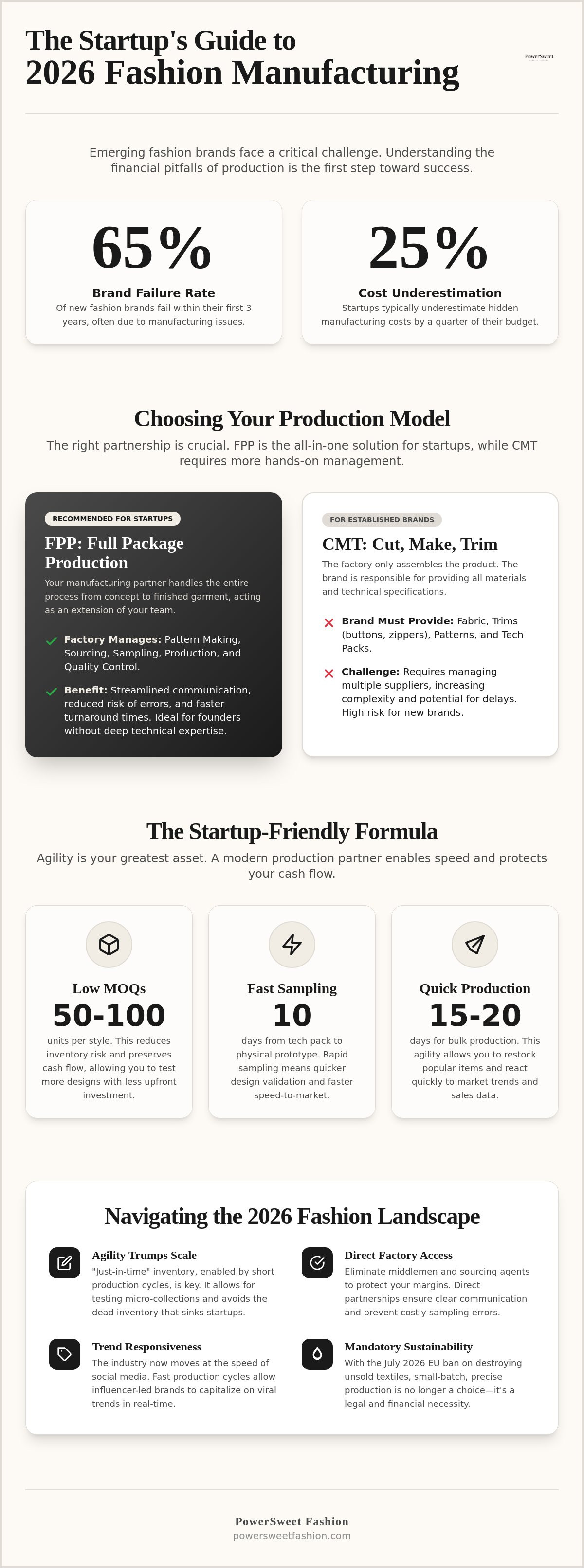
Did you know that 65% of emerging fashion brands fail within their first three years because they underestimate hidden manufacturing costs by nearly 25%? It's a harsh reality for founders who watch their cash flow disappear into high minimum order quantities (MOQs) or lose weeks to poor factory communication. You're likely looking for a reliable clothing manufacturer for startups that provides the technical precision of a major factory without the rigid requirements that kill new brands.
We understand that the gap between a creative sketch and a retail-ready garment feels massive when you're managing fabric sourcing and pattern making on your own. Speed shouldn't compromise stability. This guide will show you how to master the 2026 fashion manufacturing landscape and select a production partner that balances low MOQs with professional grade quality. We'll break down the latest industry shifts, from the EU's new textile regulations to the rise of nearshore production. You'll gain a clear, step-by-step path to fast sample turnarounds and efficient bulk production so you can test the market with confidence.
Table of Contents
The 2026 Fashion Manufacturing Landscape for Startups
The fashion industry has moved past the era of rigid, high-volume production. In 2026, the competitive edge belongs to the "Production Accelerator." This model merges design development with industrial execution, allowing founders to move from a initial concept to a finished product without juggling multiple vendors. Finding a clothing manufacturer for startups that operates as an accelerator is the difference between a successful launch and a warehouse full of unsold stock.
Traditional mass production is being replaced by agile manufacturing. This shift is driven by the rise of influencer-led brands that require high-speed cycles to capitalize on viral social trends. These brands don't plan seasons six months in advance; they plan drops based on real-time engagement data. Additionally, sustainability is now a legal mandate rather than a marketing choice. With the July 2026 EU ban on the destruction of unsold textiles, brands must produce only what they can realistically sell. This regulation is reshaping the global clothing industry, making precise, small-batch production the only viable path forward for new entrants.
Why Agility Trumps Scale in Year One
Dead inventory is the primary reason fashion startups fail. When you're forced into high minimum order quantities (MOQs), you tie up your cash in products that might not resonate with your audience. Agility allows you to pivot. By utilizing 15-20 day production cycles, you can implement "just-in-time" inventory management. This means you can launch micro-collections to test market fit. If a specific design performs well, you can restock quickly. If it doesn't, you haven't lost your entire budget on a single style. It's a pragmatic approach to scaling that prioritizes cash flow over bulk discounts.
Direct Factory Access vs. Middlemen
Working directly with a factory is a strategic move for your margins. Sourcing agents and US-based design studios often add significant markups without adding proportional value to the garment. These middlemen can also create communication gaps that lead to costly sampling errors. A direct partnership with a clothing manufacturer for startups ensures that your technical specifications are understood by the people actually cutting the fabric. Modern manufacturing now relies on digital transparency. You should expect a partner that offers clear visibility into the production journey, from fabric sourcing to final quality control. This direct line of sight reduces risk and keeps your project on schedule.
This level of logistical precision is becoming standard across various sectors; for example, specialized grocery services like Shift 2 Fresh now provide Filipino fruits vegetables online UAE by leveraging direct-from-source import models that mirror the efficiency of modern garment production.
Identifying the Right Manufacturing Model: FPP vs. CMT
Choosing the wrong operational model is a common mistake that drains startup capital before the first sale. In the garment industry, two primary frameworks exist: Full Package Production (FPP) and Cut, Make, Trim (CMT). For a founder, the choice between these models dictates how much of the supply chain they must manage personally. A clothing manufacturer for startups that specializes in FPP acts as a turn-key partner, handling everything from technical design to final shipping. Conversely, CMT requires the brand to provide the fabric, trims, and patterns, leaving the factory only responsible for the assembly.
Startups almost always benefit from a full-service production partner. Managing a fragmented supply chain involves coordinating multiple vendors, which increases the risk of delays and quality discrepancies. While the U.S. textile and apparel industry maintains high standards for domestic material production, sourcing those materials independently as a new brand is often cost-prohibitive. Evaluating a factory's sourcing capabilities for specialized women's textiles, such as high-recovery knits or sustainable silks, ensures that your designs are executed with the correct hand-feel and durability.
The Full Package Advantage
Pattern making and technical design are the foundations of garment quality. In an FPP model, these services are integrated, ensuring that the pattern maker and the production team are in constant communication. This alignment eliminates the "lost in translation" errors that occur when patterns are developed by a third party. Integrated fabric sourcing also reduces lead times and shipping costs. Since the factory leverages its own established relationships with textile mills, they can often secure better pricing and faster delivery than a startup could on its own. Professional quality control is woven into the production line, identifying issues at the source rather than after the goods have been shipped across the globe.
When to Transition to CMT
Transitioning to a CMT model typically requires significant internal infrastructure. You need a dedicated production manager to oversee fabric yields, trim inventories, and logistics. For early-stage brands, the risks of a fragmented supply chain usually outweigh the potential marginal savings on fabric costs. Most successful founders find that custom women's clothing production is more manageable when they rely on an FPP partner to handle the technical heavy lifting. If you are ready to move from concept to creation, you might review our end-to-end production capabilities to see how an integrated approach protects your margins.
The Strategic Power of Low MOQ Production
High minimum order quantities are the fastest way to drain a startup's bank account. In 2026, a clothing manufacturer for startups should offer a minimum order quantity (MOQ) between 50 and 100 units per style. This range is the new industry standard for agile brands. It allows you to offer a diverse range of colors and sizes without committing to thousands of units that might not sell. By keeping your initial investment low, you preserve capital for marketing and customer acquisition.
The "Test and Scale" strategy is a pragmatic approach to growth. Instead of launching a massive ten-piece collection, successful founders often start with just three core styles. You gather real-world sales data, see what resonates with your audience, and then double down on the winners. This methodology is explored further in our guide on the low MOQ women's clothing manufacturer model, which highlights how small-batch production drives long-term brand stability.
The Economics of Small-Batch Manufacturing
Small-batch production involves a different financial structure than mass manufacturing. You'll likely encounter a higher per-unit cost because the factory must account for setup time, machine calibration, and pattern grading over a smaller volume of garments. However, custom clothing production small batch is the ultimate risk hedge. It's better to pay a slightly higher price per garment than to have $20,000 worth of dead inventory sitting in a warehouse. When selecting a partner, look for those willing to discuss growth-based MOQs. A reliable factory will support your 50-unit launch with the understanding that successful sales will lead to larger reorders as you scale.
Maintaining Boutique Quality at Small Scale
Low volume must never mean low quality. To justify premium retail pricing, your brand requires the technical finishings and attention to detail typically associated with a boutique clothing manufacturer. You must avoid the "cheap factory" trap. Low-cost providers often achieve their prices by skipping essential steps, leading to high defect rates. On a 50-unit order, losing even five items to poor stitching or sizing errors represents a 10% loss of your sellable stock. Dedicated quality control (QC) is non-negotiable. A professional clothing manufacturer for startups maintains the same rigorous inspection standards for a small run as they do for a major industrial production.
The Sampling Blueprint: From Tech Pack to Prototype
Sampling is the bridge between a digital concept and a physical product. In the fast-moving fashion market of 2026, speed in development is a primary competitive advantage. A 10-day sample turnaround is the benchmark you should expect from a professional clothing manufacturer for startups. If the development phase drags on for months, you risk missing the trend cycle entirely. Rapid sampling allows you to iterate quickly, refine your fit, and move into bulk production while consumer interest is at its peak.
A production-ready tech pack is the foundation of this process. In 2026, this document must be more than just a sketch. It needs to include a comprehensive Bill of Materials (BOM), detailed construction notes, and precise measurement charts for every size. When your technical documentation is thorough, the factory can execute your vision with minimal back-and-forth. You should view the sampling phase as a three-stage progression:
Proto Sample: This first iteration validates the design, silhouette, and basic construction.
Fit Sample: This stage focuses exclusively on how the garment sits on the body, ensuring the drape and movement are correct.
Pre-Production Sample (PPS): This is the final "golden sample." It uses the actual bulk fabric and trims, serving as the quality contract for the entire production run.
To keep development on track, your feedback must be actionable. Avoid vague descriptions like "make it feel more premium." Instead, use annotated photos and specific measurements. If a sleeve is too long, specify exactly how many centimeters to remove. Clear, data-driven communication ensures the factory can implement changes immediately. If you are ready to begin development, start your sample development process here to see your designs come to life.
Pattern Making and Sizing Accuracy
Professional pattern making is the difference between a luxury fit and a "fast fashion" feel. High-quality patterns account for fabric shrinkage and the specific tension of different textiles. Grading is equally critical. You must ensure your size chart is consistent across different markets, whether you are targeting the US, EU, or Asian sizing standards. During the 10-day development cycle, fit tests with live models are essential. A mannequin cannot tell you if a seam is restrictive or if a waistband digs in; a human model provides the nuanced feedback needed for a truly professional garment.
Fabric Sourcing and Trim Management
Navigating modern textile markets requires deep industry connections. In 2026, founders are increasingly sourcing sustainable options like Lyocell, high-recovery Crepe, and technical performance blends. A capable clothing manufacturer for startups will offer "counter-sourcing" services. This involves finding alternative fabrics that match the texture and weight of your original choice but fit more effectively within your target price point. Don't overlook trim management. Custom buttons, high-grade zippers, and specialized labels are the small details that define your brand identity and elevate the perceived value of your collection.
Partnering for Growth: Why Startups Choose PowerSweet Fashion
PowerSweet Fashion acts as the engine for your creative vision. We don't just sew fabric; we facilitate growth. As a dedicated clothing manufacturer for startups, we've refined a system that removes the friction from women's apparel production. Our 15-20 day bulk production timeline is designed for the 2026 market. It's fast. It's reliable. It's precise. We maintain an open-door policy. This transparency allows global founders to see exactly how their collections are managed. You get the full benefits of our end to end clothing production service, which handles everything from the first pattern to the final quality check.
A Numbers-First Approach to Reliability
Experience matters in this industry. We've been operating in the women's fashion sector since 2008. Over nearly two decades, we've seen every production challenge imaginable. Our commitment to quality control is rigorous. We inspect every garment at multiple stages of its life. This ensures that your brand's reputation remains untarnished. We specialize in scaling. Whether you're starting with your first 50 units or ready to jump to 5,000, our facility adapts to your volume. We grow as you grow.
Your Next Steps to Launch
Success starts with preparation. To get a faster quote, ensure your initial design inquiry includes a clear tech pack or a detailed physical sample. Finding a reliable clothing manufacturer for startups is about more than just a price list; it's about finding a safe pair of hands for your investment. We invite you to visit our facility. Meet the people behind the machines. Seeing the physical reality of our production lines builds a different level of trust. Don't let your sketches stay on paper. Start your journey with a professional partner today.
Scale Your Creative Vision with Precision
The 2026 fashion landscape demands a partner that prioritizes speed and precision over traditional mass production. You now have the framework to choose between FPP and CMT models, manage low MOQs for market testing, and navigate the technical requirements of a production-ready tech pack. Success in this competitive market requires moving from concept to retail while consumer interest is at its peak. Selecting the right clothing manufacturer for startups ensures your capital is invested in high-quality, sellable inventory rather than dead stock.
We specialize in high-end women's apparel with a focus on industrial reliability. By offering 10-day sample turnarounds and 15-20 day bulk production, we provide the agility you need to scale from your first collection to a global brand. Our end-to-end approach handles the technical heavy lifting so you can focus on building your legacy. It's time to bridge the gap between your sketches and the physical reality of the production floor.
Launch Your Brand with PowerSweet Fashion’s Low MOQ Production. Your brand's future begins with the first prototype.
Frequently Asked Questions
How do I find a clothing manufacturer for my startup if I don't have a tech pack?
You can still begin production if the factory offers comprehensive pattern making and development services. Many founders start with a physical "reference garment" or detailed sketches rather than a digital file. A professional clothing manufacturer for startups will have an in-house technical team to help translate your vision into a production-ready blueprint. Providing a clear physical sample is often the fastest way to bridge the gap without a formal tech pack.
What is the typical minimum order quantity (MOQ) for new clothing brands in 2026?
The industry standard for agile startups has shifted toward 50 to 100 units per style. This low threshold allows brands to test market fit and maintain a diverse SKU count without overcommitting capital. While some mass-production facilities still require 300 to 500 units, specialized partners focus on these smaller batches to support brand growth and minimize the risk of unsold inventory.
How much does it cost to develop a clothing sample with a professional factory?
Sample development costs vary depending on the complexity of the design and the specific textiles required. This fee generally covers the labor for pattern making, fabric sourcing, and the construction of the prototype itself. It's a necessary investment to ensure the fit and quality are retail-ready. Some factories offer a credit toward your bulk production run once the sample is approved and the order is finalized.
Can a startup manufacture custom women's clothing overseas safely?
Overseas production is safe when you partner with established facilities that prioritize transparency and direct communication. You should look for factories with a long standing reputation and an "open-door" policy. Working with a clothing manufacturer for startups that manages end-to-end quality control ensures your garments meet international standards. Digital transparency and regular production updates help mitigate the risks of working across different time zones.
How long does the entire production process take from design to delivery?
A streamlined production cycle typically takes about 25 to 30 days once the design is finalized. This timeline includes a 10-day sampling phase followed by a 15-20 day bulk production window. You must also account for shipping, which takes 5-7 days via air freight or 3-5 weeks via sea. Planning for a 45-day window from the initial concept to warehouse arrival is a realistic baseline for most founders.
What are the biggest red flags to watch for when vetting a clothing manufacturer?
Vague communication and a lack of technical documentation are immediate warning signs. If a factory cannot provide a clear timeline for sampling or refuses to explain their quality control process, they're likely a middleman rather than a direct manufacturer. Extremely low prices that fall far below industry averages often indicate high defect rates or poor labor standards. Ensure the factory has specific expertise in women's apparel to avoid fit issues.
Do I need to source my own fabrics when working with an FPP manufacturer?
You don't need to source your own materials when utilizing a Full Package Production (FPP) model. The manufacturer manages the entire supply chain, leveraging their established relationships with textile mills to find the correct Lyocell, Crepe, or performance blends. This integrated approach reduces your logistical burden and ensures the fabric is compatible with the factory's machinery. It's a more efficient way to manage costs and lead times.
How can I protect my designs when working with a global production partner?
Protecting your intellectual property starts with choosing a partner that values long-term collaboration over one-off transactions. Established factories rely on their reputation for integrity to attract and retain global clients. You should also maintain a clear paper trail of all technical designs and communication. Filing for trademarks in your target markets provides an additional legal layer of protection for your brand's unique silhouettes and identity.


Comments