%20(1).png)
What to Include in a Fashion Tech Pack: The Ultimate 2026 Production Checklist
- Powersweet Team

- Aug 15
- 11 min read
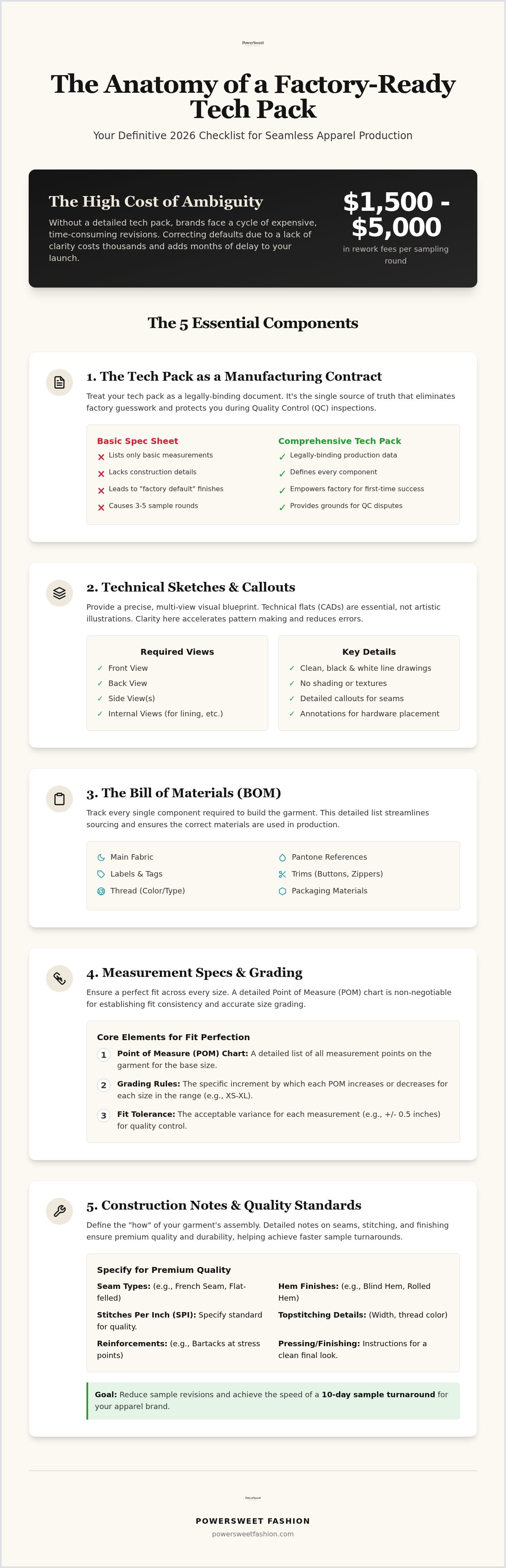
Did you know that correcting garment defaults without a proper technical foundation can cost your brand between $1,500 and $5,000 in rework fees for every single sampling round? It's a staggering price to pay for a simple lack of clarity. We understand the frustration of receiving a sample that misses the mark on fit or fabric, especially when you're racing toward a launch deadline. Mastering exactly what to include in a fashion tech pack is the difference between a seamless production run and a series of expensive, time-consuming revisions.
We'll help you master the essential components of a factory-ready document to eliminate these production errors and accelerate your brand's growth. This guide provides a definitive 2026 checklist of required documents, from detailed Bill of Materials to measurement specs for women's apparel. You'll learn how to integrate AI-assisted design data and satisfy new global compliance standards that impact your production. By the end, you'll have the tools to reduce sample turnaround times and build a more transparent, professional relationship with your manufacturing partner.
Table of Contents
The Tech Pack as a Manufacturing Contract: Why Detail Matters
A tech pack is your garment's single source of truth. It is not just a collection of drawings; it is a legally-binding manufacturing contract that translates your creative vision into an industrial reality. When you are deciding what to include in a fashion tech pack, you must view it as a blueprint for success. Without this level of technical detail, you risk falling into a cycle of three to five unnecessary sample rounds. This adds thousands of dollars in rework costs and months of delay before you even reach bulk production.
Professional brands distinguish clearly between a simple spec sheet and a comprehensive tech pack. A spec sheet typically only lists basic measurements. In contrast, a full tech pack contains every piece of production data required to build the garment from scratch. This depth is essential for establishing a reliable partnership with a custom women's clothing manufacturer. It signals that you are a serious business partner who values precision and efficiency.
Eliminating Factory Guesswork
Factories hate ambiguity. When a technical detail is missing, the production team will not stop the machines to ask for clarification. Instead, they use a "factory default" finish. This usually means the fastest or most convenient method for the sewing line, which rarely matches a premium design vision. We act as an authoritative facilitator by providing total clarity through documentation. The factory default trap is the inevitable result of missing specifications, where a manufacturer chooses the most convenient path over your specific design intent. By defining every components of a tech pack upfront, you empower the factory to get it right the first time.
The Legal and Quality Control Aspect
Beyond the design phase, these documents serve as your primary defense during quality control (QC) inspections. A signed-off tech pack is the objective standard used to judge the final product. If the bulk production arrives with incorrect seams or substituted trims, your documentation provides the legal grounds to request a remake or a refund. This rigorous approach is the backbone of successful end to end clothing production. Knowing exactly what to include in a fashion tech pack ensures that your manufacturer has no room for error, protecting your investment and your brand's reputation for quality.
Technical Sketches and Callouts: The Visual Blueprint
Visual clarity is the foundation of efficient manufacturing. When determining what to include in a fashion tech pack, your technical sketches act as the primary instruction manual for producing a fashion garment. While artistic illustrations are useful for mood boards, they have no place in a production folder. You need technical flats, also known as CADs, which provide a proportional, two-dimensional representation of your design without the distraction of artistic flair or stylized body poses.
A complete visual blueprint requires multiple perspectives. You must include front, back, and side views as standard. For complex women's apparel, internal views are equally critical to show lining construction, pocket bags, and hidden reinforcements. High-quality visuals significantly accelerate the sample development clothing manufacturer process. When a pattern maker can see exactly how a garment should look from every angle, they can move directly to drafting without second-guessing your intent.
Creating Factory-Ready CADs
Your CADs should be clean, black-and-white line drawings. Avoid shading, gradients, or textures, as these can obscure seam lines and stitch details. In 2026, professional designers are leveraging the Adobe Illustrator update with Firefly AI to generate precise technical details, though purpose-built PLM software remains the gold standard for data integration. Our team often recommends using professional pattern making experts to ensure your sketches translate perfectly into physical templates.
Detail Callouts and Annotations
Callouts are magnified views that highlight specific construction elements. You must label every seam type, topstitching width, and hardware placement. For women's fashion, focus specifically on darts, pleats, and delicate edge finishes that define the fit. To maintain absolute clarity, we follow the 10-inch rule: if a construction detail is too small to be clearly identified from 10 inches away on a printed page, it must have its own dedicated, magnified callout box. This level of precision eliminates the risk of the factory missing a critical design element during the fast-paced assembly process.
The Bill of Materials (BOM): Tracking Every Component
The Bill of Materials, or BOM, is the definitive ingredient list for your garment. It accounts for every physical item required to bring a design to life. When deciding what to include in a fashion tech pack, the BOM is where you eliminate sourcing errors. It ensures that the factory doesn't substitute a cheap polyester lining for the premium silk you intended. Every entry must be exhaustive, leaving zero room for interpretation by the procurement team.
Primary fabrics are the foundation of this document. You must specify the exact fiber content, weight in grams per square meter (GSM), and colour references using standardized systems like Pantone. In 2026, this section also serves as a critical compliance tool. With the France and Denmark PFAS bans now in effect as of January and July 2026, your BOM should explicitly state that all textiles are chemical-compliant. Secondary components like interlinings and pocket bags are equally vital. These hidden elements provide the structural integrity that defines a high-quality women's garment.
The "Trims and Sundries" list covers the remaining hardware. This includes thread types, zippers, buttons, and elastic. Even the thread weight matters; using the wrong gauge can lead to seam puckering on delicate fabrics. By providing a detailed BOM, you enable your manufacturing partner to source materials accurately and provide a precise cost estimate for production.
Sourcing for Women's Fashion
Women's apparel often relies on delicate textiles like silk, crepe, or lyocell. These materials require specific handling and expertise. Instead of sourcing blindly, leverage your manufacturer's fabric sourcing services to access established textile networks. This is often more efficient than independent sourcing. When describing these fabrics, include "hand-feel" notes. Descriptions like "sand-washed" or "high-drape" provide the factory with a sensory benchmark to match during the sourcing phase.
Hardware and Branding Components
Branding components are no longer just aesthetic choices. As of 2026, FTC labeling violations regarding fiber content or care instructions can result in penalties of up to $51,744 per item. Your BOM must clearly define the placement of main labels, care labels, and size tabs. Specify metal finishes for hardware, such as brushed gold versus polished nickel, to ensure consistency across your collection. Finally, include packaging specs. Detailed instructions for polybags, hangtags, and folding methods protect the garment during transit and maintain your brand's premium presentation upon arrival.
Measurement Specs and Grading: Ensuring the Perfect Fit
The measurement specification sheet is the most technical part of your production folder. When you're deciding what to include in a fashion tech pack, remember that the measurement chart is the DNA of your garment. It dictates the physical silhouette and drape of your women's wear line. It's the bridge between a flat drawing and a wearable garment. Without precise measurements, your factory is left to guess the proportions, which inevitably leads to the factory default trap. This lack of detail is the primary cause of the three to five unnecessary sample rounds that drain your budget.
Professional pattern making is the only way to ensure these numbers translate accurately into a 3D form. We use these specifications to create the master template that guides every cut of the fabric. Accuracy here is non-negotiable. If you want to eliminate fit errors before the first stitch is even sewn, you should leverage our expert sample development services to perfect your base size specifications.
Defining Your Point of Measure (POM)
A Point of Measure (POM) is a specific location on a garment where a measurement is taken. For women's tops and dresses, you must include the bust, waist, hip, sleeve length, and across-shoulder measurements. For trousers, focus on the rise, inseam, and leg opening. The High Point Shoulder (HPS) serves as your critical reference point for all vertical measurements. To avoid factory error, your instructions must be explicit about whether measurements are taken flat or on the body. Clear POM descriptions are essential for maintaining consistency across different production batches.
Tolerance: The QC Shield
Tolerance is the small, acceptable deviation from your spec sheet during bulk production. No factory can hit every measurement to the exact millimeter across thousands of units. However, you must define these limits. For example, a +/- 0.5cm tolerance on a bust measurement is standard for premium women's wear. If a garment falls outside this range, your tech pack provides the legal basis to reject the batch during quality control. This section of what to include in a fashion tech pack acts as your insurance policy against poor workmanship.
Grading and Size Runs
Grading is the process of scaling your base size up to XL or down to XS. You must perfect your base size, typically a Small or Medium, before you apply grading logic. Once the fit is approved, you establish grading increments. These increments are not always uniform. A grade between Small and Medium might differ from the grade between Large and XL to maintain the garment's intended look. Avoid the pitfalls of vanity sizing by using consistent, data-driven grading logic that your manufacturer can follow without confusion.
Construction Notes and Quality Standards
Construction notes provide the assembly instructions that ensure your design vision survives the industrial sewing line. When you're finalizing what to include in a fashion tech pack, these notes act as the technical manual for the sewing floor. They define the structural integrity of the piece and prevent the factory from defaulting to cheaper, faster assembly methods that compromise your brand's reputation. Detailed notes are the only way to guarantee that the quality of your bulk production matches your approved sample.
You must specify seam types based on fabric weight and the garment's end-use. French seams are a hallmark of premium women's wear, providing a clean, enclosed finish on sheer fabrics like silk or chiffon. Conversely, overlock seams are standard for most internal joins, while flatlock seams offer a chafe-free experience in activewear. Stitch-per-inch (SPI) requirements are equally critical. For high-end women's apparel in 2026, a standard of 12 to 14 SPI is the benchmark for lightweight woven fabrics to prevent seam slippage and ensure long-term durability.
Quality standards must also include hemming instructions and edge finishes. A delicate baby hem is the correct choice for a silk slip dress, whereas a wider blind hem is appropriate for a structured trouser. To protect your investment during bulk production, you must set an Acceptable Quality Level (AQL). An AQL of 2.5 is the industry standard for premium apparel, defining the maximum number of defects allowed before a batch is rejected during Quality Control Services.
The 'How-To' of Garment Assembly
Every complex garment requires annotated diagrams for non-standard construction methods. If your design features a unique placket or internal reinforcement, a visual "how-to" is mandatory to avoid factory guesswork. You should also specify thread material, weight, and colour matching, usually referenced by a specific thread brand's colour code. Guidance on fusing and interlining is vital for structured garments like blazers, ensuring the fabric maintains its shape after repeated wear. Providing this level of detail is exactly what to include in a fashion tech pack to empower the production team.
Revision History and Version Control
A tech pack is a living document. Every file must include a date-stamped revision log to track every change made during the sampling phase. This transparency is what enables our 10-day sampling speed. When you receive your first sample and provide comments, those updates must be recorded immediately in the log. This process facilitates the transition from a "Development Tech Pack" to a final "Production Tech Pack." This final version serves as the ultimate blueprint for the sewing floor, preventing the factory from using outdated patterns or old construction methods for your bulk order.
Accelerating Your Production Journey
A comprehensive tech pack is the ultimate tool for scaling your women's apparel brand with confidence. By mastering exactly what to include in a fashion tech pack, you protect your investment and eliminate the cycle of costly sample revisions. You've learned that precise technical flats, an exhaustive Bill of Materials, and rigorous grading rules are not just suggestions. They are the industrial standards that define a successful manufacturing partnership and ensure your garment's DNA remains intact from the first sketch to the final stitch.
Transitioning from a creative vision to physical reality requires a partner that values precision as much as you do. We provide the end-to-end sourcing and production management needed to bring your collection to life without the typical industry friction. Whether you're an emerging brand looking for low MOQ options or an established label requiring our 10-day sample development speed, we are here to support your growth. We bridge the gap between digital design and industrial execution with meticulous care.
Ready to start production? Let PowerSweet Fashion turn your tech pack into reality.
Your vision deserves a production process that is as meticulous as your design. We're ready to help you take the next step in your brand's evolution.
Frequently Asked Questions
What is the difference between a tech pack and a spec sheet?
A spec sheet is a limited document that focuses primarily on garment measurements and points of measure. In contrast, a tech pack is a comprehensive production manual. It includes technical sketches, a full Bill of Materials, construction notes, and quality standards. While a spec sheet tells the factory the size, the tech pack provides the complete roadmap for every stage of assembly.
Do I need to be a designer to create a tech pack?
You don't need to be a classically trained designer, but you must have a deep understanding of technical garment construction. Many brand founders work with technical designers or professional pattern makers to ensure their data is factory-ready. This collaboration is essential to translate a creative vision into the precise, industrial language required for a successful manufacturing run.
Can a factory create a tech pack for me?
Yes, full-service manufacturers often provide tech pack creation as part of their sample development services. We frequently assist clients in refining their technical documentation to ensure it aligns with our specific production capabilities. This collaborative approach helps prevent errors early in the process and ensures that the final document accurately reflects the intended design and fit standards.
How much does it cost to have a professional tech pack made?
The cost of professional tech pack creation varies significantly based on the complexity of the garment and the expertise of the technical designer. While we don't quote specific service fees here, industry professionals report that high-quality documentation is a strategic investment. It prevents rework costs that can reach thousands of dollars per style, making it a vital part of your production budget.
What software is best for creating fashion tech packs in 2026?
Adobe Illustrator remains the industry standard, especially with the 2026 Firefly AI updates that assist with rapid technical detailing. Many professional designers also use specialized PLM platforms like Techpacker or 3D simulation tools like CLO 3D. These programs help brands manage exactly what to include in a fashion tech pack while ensuring version control is maintained across the entire design team.
Does a tech pack include the actual clothing pattern?
A tech pack and a pattern are separate but interlinked assets. The tech pack provides the instructions, measurements, and material data, while the pattern is the physical or digital template used to cut the fabric. However, the tech pack is the foundation used for pattern making. Both must be perfectly synchronized to ensure the final garment matches your original specifications.
How many pages should a standard tech pack be?
A standard tech pack typically spans 5 to 10 pages depending on the garment's complexity. A simple women's t-shirt might only require five pages, while a structured blazer with internal linings and complex hardware can easily exceed ten. Every page should serve a specific purpose, such as detailing the Bill of Materials, technical sketches, or the point of measure charts.
What happens if I send an incomplete tech pack to the manufacturer?
Sending incomplete documentation forces the factory to make assumptions, which often leads to the "factory default" trap where they choose the easiest assembly method. This usually results in three to five unnecessary sample rounds and significant financial waste. It is the primary reason garments arrive with incorrect fits or fabrics, which can severely delay your brand's market entry.


Comments