
RN numbers for clothing: Label Rules and Company Lookup

An RN number can identify a clothing company, but it can’t prove when a garment was made. If you’re wondering what RN numbers for clothing mean, they are identification numbers assigned to businesses that make, import, distribute, or sell textile, wool, or fur products in the United States. Clothing labels don’t have to show an RN: a business can use its company name instead.
It’s understandable to mistake a number on a label for a date code. RN numbers may offer clues about a garment’s age, but they don’t establish its production date. The same number can appear on different styles, colors, and sizes from one business.
This guide explains who issues U.S. RN numbers, how to look up the associated company in the Federal Trade Commission’s database, and what an RN can and can’t reveal about a garment’s age. It also explains how RN numbers differ from Canada’s CA numbers, so you can read a label with more confidence.
Table of Contents
Are RN Numbers Required on Clothing Labels?
No. U.S. clothing labels don’t have to display an RN number. Businesses may identify themselves by company name or RN. The number identifies a business connected with textile products, not the garment’s country of origin, fiber content, or production date. One business can use the same RN across different garments, styles, colors, and sizes, rather than applying for a separate number for each item.
U.S. textile labeling rules are associated with two laws: the Textile Fiber Products Identification Act, related to RN compliance, and the Wool Products Labeling Act, connected to the introduction of RN numbers. Both were established in the United States in 1959. An RN is therefore one possible business identifier on a label, not a substitute for other label information.
Country-of-origin information and an RN offer different clues. When a label includes both, the origin wording names a country, while the RN can help identify the associated business. Neither detail alone establishes the exact place or date of every production step. Older labels may also show historical country names. A name that later changed can provide historical context, but it doesn’t prove a garment’s age by itself.
What is the difference between an RN number and a CA number? A U.S. RN identifies a business associated with textile products; Canada’s CA number identifies textile dealers. They are separate identifiers used in different national contexts, so a CA number is not a U.S. RN.
When reading a label, separate the clues: treat the RN as a business identifier, origin wording as a country clue, and historical country names as context. An RN isn’t transferable between companies, so a new legal entity must apply for its own number. This distinction matters when a company changes or a label refers to an earlier business identity.
Consumer protection and product traceability
An RN lookup can connect a clothing label to a business record. The Federal Trade Commission provides an online directory for searching RN numbers higher than 04086. Enter the number as printed, preserving any leading zero, then compare the returned business name with the label. This gives consumers and vintage enthusiasts a practical starting point for identifying the company associated with an item.
Treat the result as an identification clue, not a complete history of the garment. The FTC directory may be outdated because it reflects information supplied when the original RN application was submitted. A listed business name might not reflect later changes in ownership, business structure, or operations. The directory also doesn’t establish where a particular garment was made or who handled each production stage.
For a useful lookup, keep the label details together. Record the RN exactly, note the nearby business name, and compare it with the directory entry. If the entry differs, the mismatch could reflect older application information, not a definitive explanation of the garment’s path. Fiber descriptions, origin wording, and care details provide separate label clues; the RN identifies the associated business.
That distinction supports more careful consumer research. An RN can help narrow down which company to investigate when a question concerns the business behind a textile product. By itself, it cannot verify a seller, authenticate a vintage garment, confirm product quality, or prove a manufacturing date. For example, a collector can use the directory’s business name as one reference point, then compare it with the garment’s other markings and physical details.
Use the FTC result as a starting record, not a final verdict. The number links a label to an associated business, while the directory’s age may limit how accurately it reflects that business today. Keeping these limits in mind helps consumers use RN information for identification without treating it as complete product traceability.
RN numbers and clothing dates
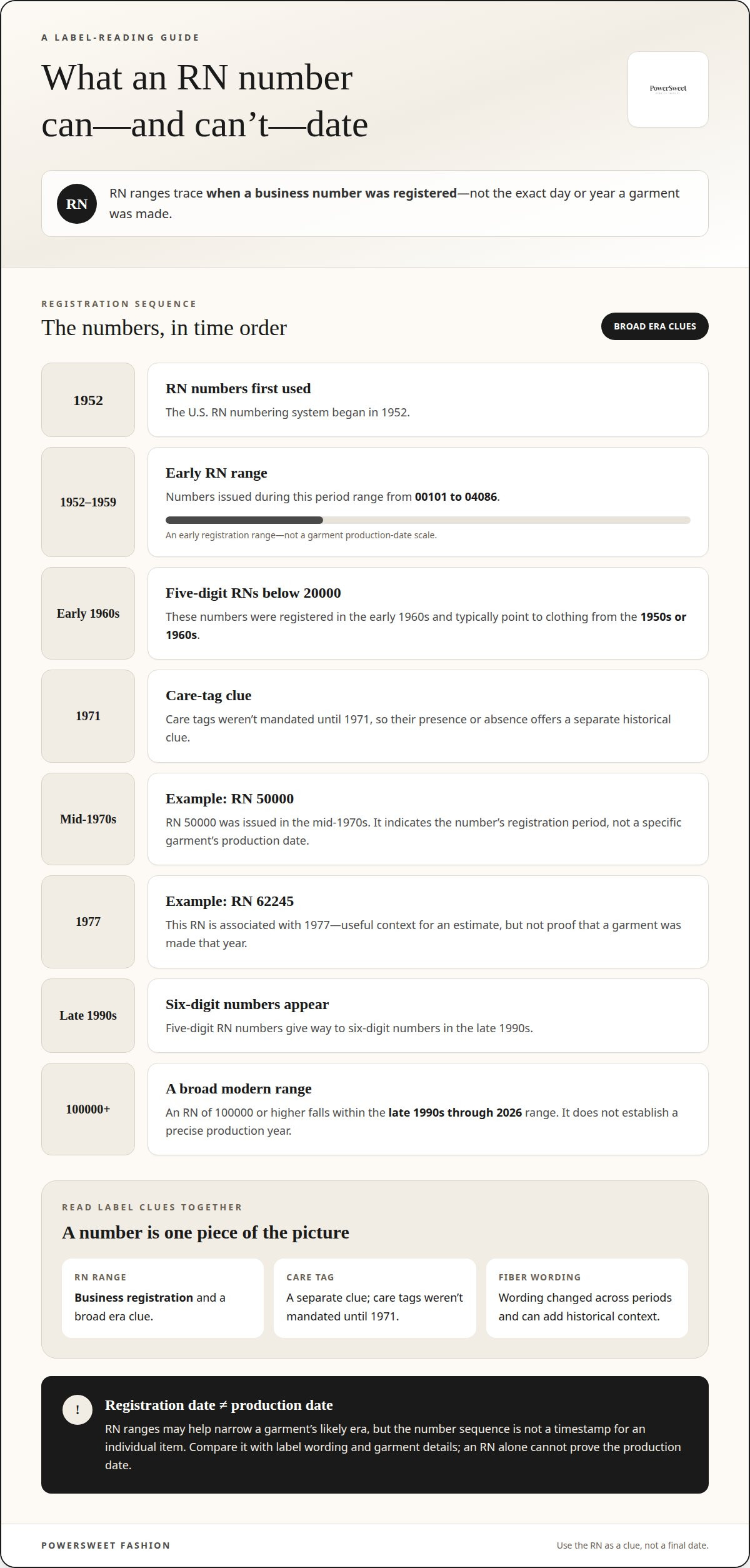
An RN number helps place a garment in a broad era, but it isn’t a production date. RN numbers were first used in 1952, and numbers issued from 1952 through 1959 range from 00101 to 04086. That early sequence gives vintage dating a useful starting point. It dates the registration sequence, not the day a specific garment left a factory.
Number length and range add context. Five-digit RNs below 20000 were registered in the early 1960s and typically point to clothing from the 1950s or 1960s. RN ranges can offer broad clues to a garment’s likely era, but they don’t establish when it was produced. RN 50000, for example, was issued in the mid-1970s, while RN 62245 is associated with 1977.
The sequence changed over time. Five-digit RN numbers give way to six-digit numbers in the late 1990s. An RN of 100000 or higher falls within the late 1990s through 2026 range. These ranges can help narrow a dating estimate, but RN-based dating does not establish a precise production year. The commission’s number sequence is a clue about registration, not a timestamp attached to each garment.
Use other label evidence alongside the RN. Care tags weren’t mandated until 1971, so their presence or absence offers a separate historical clue. Fiber wording also changed across periods: wool-content marks have distinct date ranges, including the 100% wool mark for garments no older than 1963. A five-digit RN and a care tag, for example, should be read together rather than treated as independent proof of one exact year.
The practical takeaway is simple: use the RN range to identify a likely era, then compare it with the label wording and garment details. A number alone can’t prove the production date, even when its registration period is clear.
Who issues RN numbers in the United States?
In the United States, the Federal Trade Commission (FTC) issues RN numbers. It assigns them to businesses involved in manufacturing, importing, distributing, or selling textile, wool, or fur products. The number identifies a business connected with covered products, not a factory or individual garment. An RN may therefore identify an importer or distributor rather than the facility that assembled the clothing.
The statutory identification role is specific. According to the U.S. Government Publishing Office, the Commission issues and registers the identification used for a textile product’s manufacturer or other persons subject to section 70a. This explains why the RN points to a responsible business identity within the U.S. labeling framework. It doesn’t, on its own, describe where every production step took place.
Businesses obtain an RN by applying to the FTC. RN numbers are free to obtain and are typically assigned within a few days. Registration is associated with the applying business, so the number serves as an identifier, not a style code or product approval. One registered business can use its RN across different products rather than obtaining a separate number for every garment design.
The FTC’s role also clarifies what an RN does not establish. It identifies a business associated with textile, wool, or fur products; it doesn’t certify garment quality, verify a specific factory, or provide a production date. For example, an RN on a clothing label can help connect the item to a business, but the number alone can’t confirm which facility made it. That distinction matters for brands planning labels and production records.
For a women’s apparel line, coordinated garment development and manufacturing can keep product decisions aligned. Explore custom women’s clothing production as you plan the garments behind your label.
PowerSweet Fashion: Custom Women's Clothing Production
PowerSweet Fashion helps fashion brands turn clothing concepts into production-ready women’s garments. If RN research has clarified the label details you need, custom women’s clothing production can take your product from design decisions to finished garments.
Sample Development gives you a physical sample to assess before bulk production. Fabric Sourcing supports material selection, while Quality Control Services help keep production checks aligned with your requirements. These steps are useful when your label plan needs to match the garment’s materials and manufacturing details.
Samples are ready in 10 days, and bulk production takes 15-20 days. Share your garment concept and production requirements to start shaping the next stage. Contact PowerSweet Fashion to discuss your women’s clothing production needs.
Turn label insights into a production-ready plan
Understanding what RN numbers for clothing can tell you helps separate label identification from decisions about your own garments. The next step is to turn your design, materials, and labeling requirements into a clear production brief. Aligning these choices early can focus development and keep garment details consistent as the project moves forward.
PowerSweet Fashion offers Custom Women's Clothing Production, Sample Development, and Fabric Sourcing. These services connect a garment concept with material selection and a sample for review before production planning advances.
Bring your design direction and project requirements together, then contact PowerSweet Fashion for help with your next women’s clothing project. A clear starting point can make the path from concept to garment more manageable.
Frequently Asked Questions
What is an RN Number?
An RN number is a U.S. identification number associated with a business handling textile, wool, or fur products. The Federal Trade Commission issues these identifiers. To understand what RN numbers for clothing are, think of them as business references printed on some labels, not unique codes assigned to each garment. A number can point to a responsible company without identifying the particular factory or production date.
What does an RN number mean on clothing?
On a clothing label, an RN indicates a business associated with the product under the U.S. identification system. It doesn’t describe the garment’s size, fabric quality, or design. For example, the same business identifier may appear on different pieces in a collection. Read it as one company clue, separate from fiber descriptions, care instructions, and origin wording.
What is an RN number used for on clothing labels?
An RN gives a business a compact alternative to printing its full company name on a textile label. This can make the business identity easier to fit on a small tag, such as an inside-neck label. It isn’t a product approval or a code for a particular style. Its practical function is identification; other label details communicate different product information.
How can I look up a clothing RN number?
Use the Federal Trade Commission’s online RN directory to search numbers higher than 04086. Enter the digits as printed, including any leading zero, and compare the result with the label’s wording. For instance, if a tag shows an RN and a separate brand name, the directory result can help identify the associated business. Treat older directory details as a business record, not a complete product history.
What information must appear on U.S. clothing labels?
An RN number isn’t required: a business may identify itself by company name or RN. U.S. textile labeling is connected with the Textile Fiber Products Identification Act and the Wool Products Labeling Act. Fiber content and country-of-origin wording are also useful label details, but the RN doesn’t replace them. Read each marking for its own purpose rather than treating one identifier as the whole label.
Can an RN number identify a clothing brand or manufacturer?
An RN can help identify the business associated with a clothing item, but it doesn’t necessarily name the consumer-facing brand or the factory that made the garment. A label might show a brand name alongside an RN linked to another company involved in the product. Use the RN as one lead to identify the responsible business, not as proof of a specific manufacturing location.
Comments