
How to Fix Inconsistent Sizing in Clothing Production: A Technical Guide

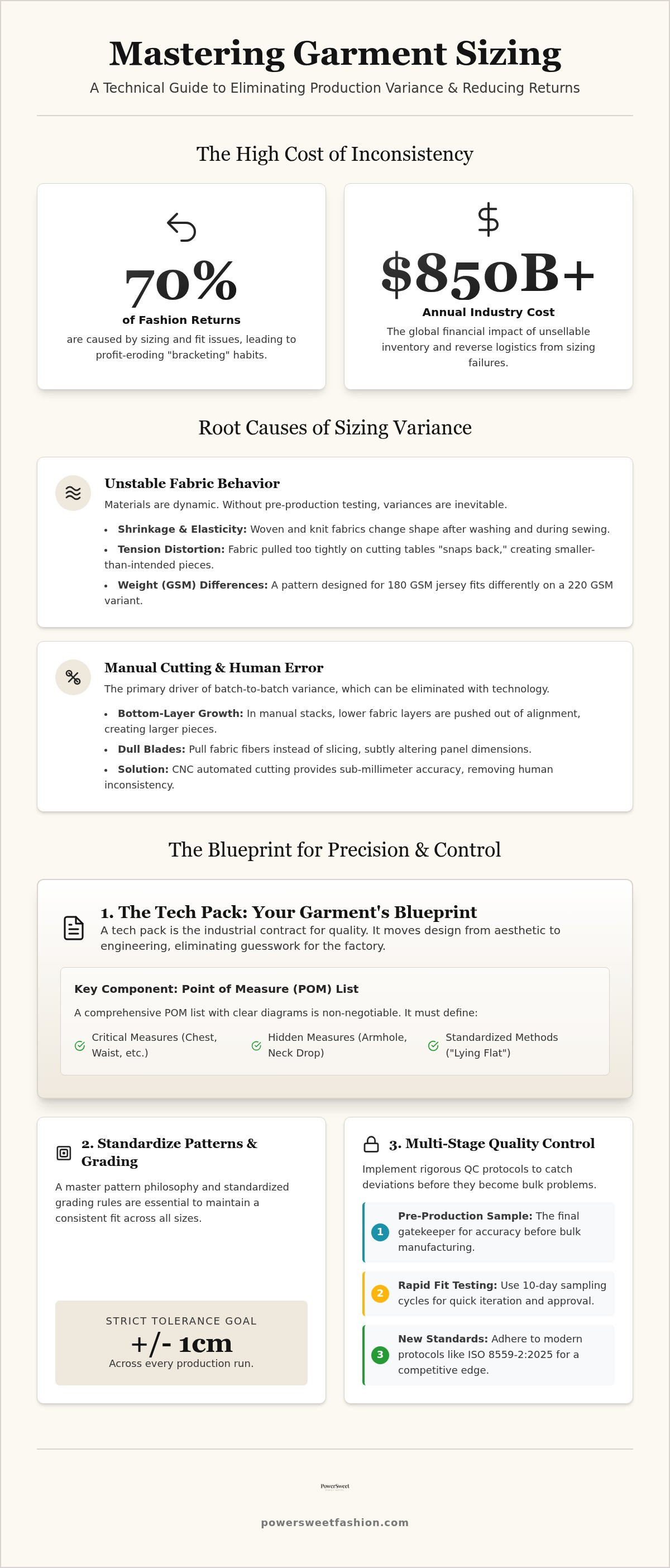
In 2026, sizing and fit issues account for up to 70% of all fashion returns. This single technical failure costs the global industry over $850 billion annually and forces consumers into "bracketing" habits that erode your profit margins. You likely feel the weight of this challenge every time a bulk shipment arrives with variances that make your inventory unsellable. It's a frustrating reality where a successful design is undermined by inconsistent execution on the factory floor.
Mastering how to fix inconsistent sizing in clothing production requires moving beyond basic measurements and into rigorous engineering. We're here to help you bridge that gap. This guide provides the technical protocols and quality control measures required to eliminate sizing variances and stabilize your manufacturing pipeline. Precision starts with the pattern. You'll learn how to implement a master pattern philosophy and standardize grading to achieve a strict +/- 1cm tolerance across every production run. We'll also preview the repeatable QC processes and new ISO 8559-2:2025 standards that will protect your brand reputation and your bottom line.
Table of Contents
The Root Causes of Sizing Inconsistency in Clothing Production
Sizing inconsistency occurs when the physical garment deviates from the tech pack's technical specifications. It isn't just a minor error; it's often the result of cumulative variances in human labor, mechanical settings, and material behavior. While many brands blame the factory, the root cause usually lies in a lack of standardized technical protocols throughout the manufacturing journey. Understanding how to fix inconsistent sizing in clothing production begins with these fundamental mechanical and material controls.
Marketing trends often complicate this technical process further. The industry's historical reliance on the U.S. standard clothing size, which was eventually abandoned for private brand standards, led to the "vanity sizing" trap. When marketing departments prioritize psychological comfort over technical accuracy, it creates a moving target for production teams. This shift makes it harder to maintain a stable baseline across different product lines and factory partners.
Fabric Behavior and Pre-Production Testing
Materials are rarely stable. If you don't calculate shrinkage and elasticity before the first cut, your final product won't match your samples. Different wash cycles can shrink a woven cotton by significant percentages, while a knit might expand under its own weight during the sewing process. Learning how to fix inconsistent sizing in clothing production requires a deep dive into these material variables during the development phase.
Fabric tension during the spreading process is another silent killer of consistency. When fabric is pulled too tightly across the cutting table, the individual panels "snap back" once cut. This leads to distorted pieces that are smaller than the pattern intended. Additionally, the fabric weight (GSM) dictates how a pattern drapes. A pattern designed for a 180 GSM jersey fits differently if produced in a 220 GSM variant, even if the measurements are identical.
The Dangers of Manual Pattern Cutting
Human error remains the primary driver of batch-to-batch variance. In many facilities, manual cutting involves stacking dozens of fabric layers. This often causes "bottom-layer growth," where the weight of the cutting machine pushes the lower layers out of alignment. The result is a top layer that fits perfectly and a bottom layer that is a full size too large. Precision requires a shift from manual hand-cutting to CNC automated cutting wherever possible.
Automated systems follow digital markers with sub-millimeter accuracy, eliminating the variance introduced by a tired operator or a dull blade. Dull blades are particularly problematic; they pull at the fabric fibers rather than slicing through them, which subtly alters the dimensions of every panel before it even reaches the sewing line. Maintaining sharp tools and digital precision is essential for achieving a repeatable fit.
Precision Starts with the Tech Pack and Master Pattern
A tech pack is the industrial blueprint for your garment. Without it, factories are left to interpret design intent, which is the fastest way to invite sizing errors. Learning how to fix inconsistent sizing in clothing production requires a shift from aesthetic design to technical engineering. When you work with a professional sample development clothing manufacturer, this document acts as the legal contract for quality. It eliminates guesswork by defining every stitch, seam, and measurement before the bulk production begins.
Developing a Comprehensive Point of Measure (POM) List
A POM list is more than just a table of numbers. It requires clear diagrams showing exactly where each measurement starts and ends. Many brands rely on outdated data, but as the research on Body Dimensions for Apparel suggests, modern body shapes require updated anthropometric standards to achieve a true fit. Your POM list should leave no room for interpretation. We recommend including the following critical elements:
Critical Measures: Define the chest, waist, hip, sleeve length, and across-shoulder widths.
Hidden Measurements: Include neck drop, armhole curvature, and pocket placement to maintain proportions.
Standardized Methods: Specify if measurements are taken "lying flat" or "on a form" to ensure the QC team uses the same process as the pattern makers.
The Importance of the Master Pattern
The master pattern, usually a size Medium, is the foundation of your entire range. If this pattern isn't perfected, every graded size will carry the same errors. A custom women's clothing manufacturer uses digital CAD software to ensure mathematical accuracy in every curve. This digital precision allows for consistent "brand DNA" across different collections, ensuring that a "Medium" fits the same way every season.
Once the master pattern is finalized, you must produce a "Gold Sample." This is the physical benchmark. It's the final version that both the brand and the factory sign off on. Every bulk run is then measured against this physical piece to ensure absolute compliance. If you're struggling with fit, our sample development services can help refine your technical blueprints before you scale.
By establishing these benchmarks early, you create a repeatable system. This system ensures that the technical vision in your office matches the physical reality of the factory floor. Precision isn't an accident; it's the result of a well-documented technical process.
Standardising Pattern Grading and Tolerance Levels
Grading is a mathematical exercise, not a design choice. It is the specific process of scaling your master pattern into a full size range while maintaining the original fit and silhouette. Many brands struggle with an XL that feels restrictive in the shoulders but loose in the waist; this usually stems from a reliance on linear grading. Mastering how to fix inconsistent sizing in clothing production requires you to move beyond simply "adding an inch" and instead implement proportional grading rules that account for how body volume actually shifts.
Communication is the final step in this process. You must provide your factory with a clear grading sheet that specifies the exact "grade jumps" for every point of measure. Without these instructions, factories often revert to their own internal defaults, which may not align with your brand's specific fit identity. Digital grading through CAD software is the most reliable way to minimize human calculation errors and ensure that every size in your run is a mathematical reflection of your "Gold Sample."
Establishing Industry-Standard Tolerance Levels
Tolerance is your technical safety net. It defines the acceptable margin of error for every measurement on your spec sheet. No production run is 100% perfect, but setting strict limits prevents "size creep" where a Small starts to fit like a Medium. Woven garments generally require a tighter tolerance of +/- 1cm to 1.5cm. In contrast, knit and stretch fabrics often need a wider allowance of +/- 2cm because the material is more volatile during the sewing and pressing stages.
Critical areas require even more precision. While you might allow a 2cm variance on a bottom hem, you should never allow that much deviation in the neckline or armhole. These "fit-critical" points dictate the entire garment's structure. If the armhole is off by even 1cm, it can change the way the sleeve hangs and the way the wearer moves. We recommend highlighting these critical zones in your tech pack to ensure the QC team prioritizes them during inspection.
Technical Grading Rules for Women's Wear
Women's apparel construction is complex because body proportions change at different rates across size brackets. A "grade jump" is the amount of change between sizes. For example, you might use a 1-inch jump between Small and Medium, but move to a 1.5-inch or 2-inch jump for plus sizes to maintain comfort. Understanding these nuances is essential when learning how to fix inconsistent sizing in clothing production across a diverse customer base.
Proportional grading also means adjusting the length of a garment, not just the width. As sizes increase, the vertical measurements, such as the torso length or the rise in trousers, must be adjusted to keep the garment's balance. Using professional pattern making services ensures these adjustments are calculated correctly. Digital tools allow our team to visualize these jumps before any fabric is cut, reducing the risk of expensive fit errors in your bulk inventory.
Implementing Multi-Stage Quality Control Protocols
Quality control is often treated as a lagging indicator, but for successful brands, it functions as a leading technical audit. If you wait until your inventory arrives at the warehouse to check measurements, you have already lost the opportunity to correct errors. Understanding how to fix inconsistent sizing in clothing production relies on a multi-stage protocol that catches variances before they become systemic across an entire batch. Precision is non-negotiable. Our system prioritizes transparency, allowing for factory visits and real-time oversight to ensure every garment meets the agreed-upon standards.
The Pre-Production (PP) sample acts as the final gatekeeper. It is the physical proof that the factory understands your grading and construction requirements. Once this sample is signed off, it becomes the "sealed" benchmark. No bulk cutting should ever commence without this reference point in place. During the actual run, we utilize Inline Inspection to measure garments while they are still on the sewing line. This allows us to pause production and recalibrate machinery immediately if a variance is detected, rather than discovering the issue after thousands of units are finished.
The 4-Point System for Fabric and Garment QC
A systematic approach to inspection prevents the most common causes of size drift. We follow a rigorous four-step process to maintain batch-to-batch consistency:
Step 1: Fabric Inspection. We verify the material for flaws and shrinkage rates before the knife touches the cloth.
Step 2: Initial Sewing Line Check. Technicians audit the first pieces off the line to ensure seam allowance accuracy.
Step 3: Mid-Production Measurement. We measure 5% to 10% of the batch during assembly to catch "size creep" early.
Step 4: Final Measurement. Every finished garment is checked against the Tech Pack before packing.
Final Random Inspection (FRI) using the AQL (Acceptable Quality Level) standard provides the statistical confidence needed for bulk approval. For professional women's apparel, an AQL of 2.5 for major defects is the industry benchmark. If you need a partner who prioritizes these rigorous protocols, explore our Quality Control Services to secure your next production run.
How to Conduct a Professional Fit Session
Live fit models are superior to static mannequins because they provide feedback on realistic movement. A mannequin cannot tell you if a high-waist trouser pinches when sitting or if a blazer sleeve restricts arm rotation. During these sessions, all comments must be documented in a Fit Tracking sheet that is shared with the factory. This document bridges the gap between subjective feel and objective technical adjustment. By maintaining a "sealed" sample that remains at the factory, you ensure the production team has a physical goal that matches your approved fit.
Partnering for Precision: How PowerSweet Fashion Ensures Accuracy
Solving the technical challenges of garment variance requires a partner who treats engineering as a priority rather than an afterthought. At PowerSweet Fashion, we understand that learning how to fix inconsistent sizing in clothing production is only half the battle. The real value lies in the execution. By leveraging end to end clothing production, we eliminate the communication gaps that typically occur when brands juggle multiple vendors for sourcing, pattern making, and assembly.
Our 10-day sampling process is designed specifically for rapid fit iterations. It allows you to test your patterns in physical form and make corrections before the bulk fabric is even ordered. This speed doesn't come at the expense of precision. It's powered by our in-house pattern making team that works alongside our sourcing experts to ensure your chosen fabric's shrinkage profile is accounted for from the very first draft. This integrated approach is how we maintain a consistent fit across diverse collections.
Direct Access to Production Teams
We operate with a policy of open-door transparency. Working directly with our factory floor eliminates the "middle-man" errors that often plague offshore manufacturing. You don't have to worry about your technical specifications being lost in translation. We invite clients to conduct factory visits to oversee QC protocols and participate in the inspection process. This direct line of communication allows for real-time problem-solving during bulk runs. If a machine setting needs adjustment or a seam allowance is drifting, we catch it and fix it in minutes, not days.
Specialised Women's Wear Expertise
Complex silhouettes require a deep understanding of drape and tension. We specialize in intricate women's apparel, from structured tailored blouses to the fluid lines of premium resort wear. Our team has extensive experience handling volatile fabrics like Lyocell, Crepe, and Polyamide. We know these materials behave differently under heat and tension, so we apply specific technical adjustments to ensure the final measurements match your spec sheet perfectly.
Our model as a low MOQ women's clothing manufacturer is built to support boutique brands that demand high-level precision. You don't need to produce thousands of units to receive professional-grade technical oversight. We apply the same rigorous engineering and QC standards to every order, regardless of scale. This commitment to accuracy is what makes us a safe pair of hands for your brand's growth and reputation. We don't just make clothes; we build the technical systems that ensure your customers get the perfect fit every time they order.
Achieving Technical Precision in Your Next Production Run
Sizing consistency is the result of rigorous engineering and disciplined quality control. By moving from aesthetic guesswork to data-driven tech packs and standardized grading, you protect your brand from the high costs of returns and inventory loss. We've explored how to fix inconsistent sizing in clothing production through master patterns, strict tolerance enforcement, and multi-stage inspections that catch errors before they scale. These protocols aren't just suggestions; they are the technical requirements for any brand looking to build long-term customer trust.
PowerSweet Fashion has been a specialist in complex women's fashion since 2008. We provide the technical infrastructure you need to ensure every garment fits exactly as intended. With our 10-day sample turnaround for rapid fit testing and low MOQ options for scaling brands, we help you achieve industrial-grade accuracy without the barriers of massive production runs. Our end-to-end approach ensures that your technical vision is maintained from the first pattern to the final delivery.
Get a precise quote for your next production run at PowerSweet Fashion and secure the stability of your supply chain today.
Your brand deserves the reliability of a partner who understands the mechanics of fit. Let's work together to turn your design vision into a perfectly executed reality.
Frequently Asked Questions
What is the acceptable tolerance for clothing measurements in manufacturing?
Industry standards for measurement tolerance vary based on the fabric type and construction complexity. Woven garments typically maintain a tolerance of +/- 1cm to 1.5cm, while knit and stretch fabrics allow for +/- 2cm because the material is more volatile. Critical points like necklines and armholes require much stricter adherence than non-critical areas like bottom hems. Establishing these boundaries early in your tech pack is essential for maintaining production quality.
How do I create a tech pack to ensure consistent sizing?
A comprehensive tech pack must include a detailed Point of Measure (POM) list with clear diagrams. You should define exactly where each measurement starts and ends to remove factory guesswork. Including a grading sheet with specific "grade jumps" ensures that scaling is mathematical rather than estimated. This document serves as the technical blueprint for how to fix inconsistent sizing in clothing production and acts as your contract for quality.
Why does my clothing fit differently in different colours of the same fabric?
Different dyes and chemical treatments affect fabric behavior, even within the same textile type. Darker dyes often require longer immersion times or higher temperatures; this can lead to higher shrinkage rates compared to lighter shades. To prevent fit discrepancies, you must conduct shrinkage testing for every colorway before the cutting phase begins. Adjusting the pattern for each specific fabric batch ensures a uniform fit across your entire multi-color collection.
What is the difference between pattern making and pattern grading?
Pattern making is the creation of the initial "master pattern," typically in a size Medium. This foundational step establishes the garment's silhouette and construction details. Pattern grading is the subsequent mathematical process of scaling that master pattern into larger and smaller sizes. While pattern making defines the brand's aesthetic DNA, professional grading ensures that the fit remains proportional and comfortable across your entire size range without losing the original design intent.
How can I fix sizing issues if my bulk production has already started?
If bulk production is already underway, you should immediately perform an "inline inspection" to identify the source of the variance. If the issue stems from incorrect seam allowances or machine settings, the production line can be recalibrated for the remaining units. For pieces already cut or sewn, options are limited to minor alterations or re-classifying the stock. Prevention through a signed-off pre-production sample remains the most cost-effective strategy for brands.
Should I use a live fit model or a mannequin for size testing?
You should prioritize live fit models for realistic movement testing. While mannequins provide a stable base for static measurements, they cannot provide feedback on comfort, range of motion, or how a fabric pinches during wear. A live model helps you identify technical fit issues that a plastic form would miss. Documenting these sessions in a fit tracking sheet ensures clear communication with your manufacturing team and leads to a better end-product.
How often should I conduct quality control inspections during production?
Inspections should occur at four critical stages: fabric arrival, initial sewing, mid-production, and final finishing. Checking the first pieces off the line allows you to catch errors before they affect the entire batch. Mid-production audits of 10% of the inventory help detect "size creep" or mechanical drift. This multi-stage approach is a primary method for how to fix inconsistent sizing in clothing production and ensures that your final shipment is accurate.
Does fabric shrinkage affect all sizes equally in a production run?
Shrinkage is a percentage-based reaction, meaning larger garments will lose more total length and width than smaller ones. If a fabric shrinks by 5%, an XL garment will physically decrease in size more than an XS. You must account for these mathematical variances during the pattern making phase. Testing fabric swatches from the bulk roll ensures your grading rules remain accurate after the final wash or press, preventing batch-to-batch fit issues.


Comments