%20(1).png)
What Fashion Brands Need to Know Before Manufacturing Clothing in China
- Powersweet Team

- Jul 8
- 11 min read
In 2026, the belief that manufacturing clothing in China is strictly for high-volume legacy brands is officially obsolete. While total apparel exports reached $24.87 billion in early 2026, a 14.8% year-on-year increase, the real story is the shift toward flexible, high-tech partnerships. You've likely worried that moving production offshore means losing control over fabric quality or getting stuck in a cycle of endless sampling delays. It's a common fear. A single communication breakdown can derail an entire seasonal launch and leave you with inventory that doesn't match your tech pack.
We're here to bridge that gap and turn your creative vision into a scalable reality. You'll learn how to master the complexities of the current garment supply chain, from navigating the new 13% VAT framework to meeting the strict standards of the 2026 Ecological and Environmental Code. This article provides a clear roadmap for transitioning from design to bulk production with speed and precision. We'll show you how to identify partners that offer low MOQs and fast turnarounds, ensuring your brand stays agile and confident in the 2026 logistics landscape.
Table of Contents
The Evolution of Manufacturing Clothing in China in 2026
The 2026 Chinese manufacturing ecosystem is a high-velocity network built on technical precision and immediate material access. It isn't the same landscape it was a decade ago. Today, manufacturing clothing in China means leveraging an infrastructure that has pivoted from sheer volume to extreme responsiveness. For fashion brands, this evolution represents a shift toward agile manufacturing, where seasonal launches are no longer dictated by rigid six-month lead times but by real-time market demand.
China remains the dominant leader for womenswear because of its deeply specialized supply chains. Unlike emerging markets that may only offer basic assembly, the Textile industry in China provides an end-to-end environment where design, sourcing, and production happen in a single, interconnected hub. This proximity allows for a level of complexity in women's apparel, such as intricate draping, delicate lace work, or mixed-media fabrics, that other regions struggle to replicate at scale. By 2026, global delivery windows have shortened significantly. Modernized logistics and streamlined customs processes mean that a collection finished on a Monday can often be in a London or New York warehouse by the following week.
The "One-Stop" Manufacturing Advantage
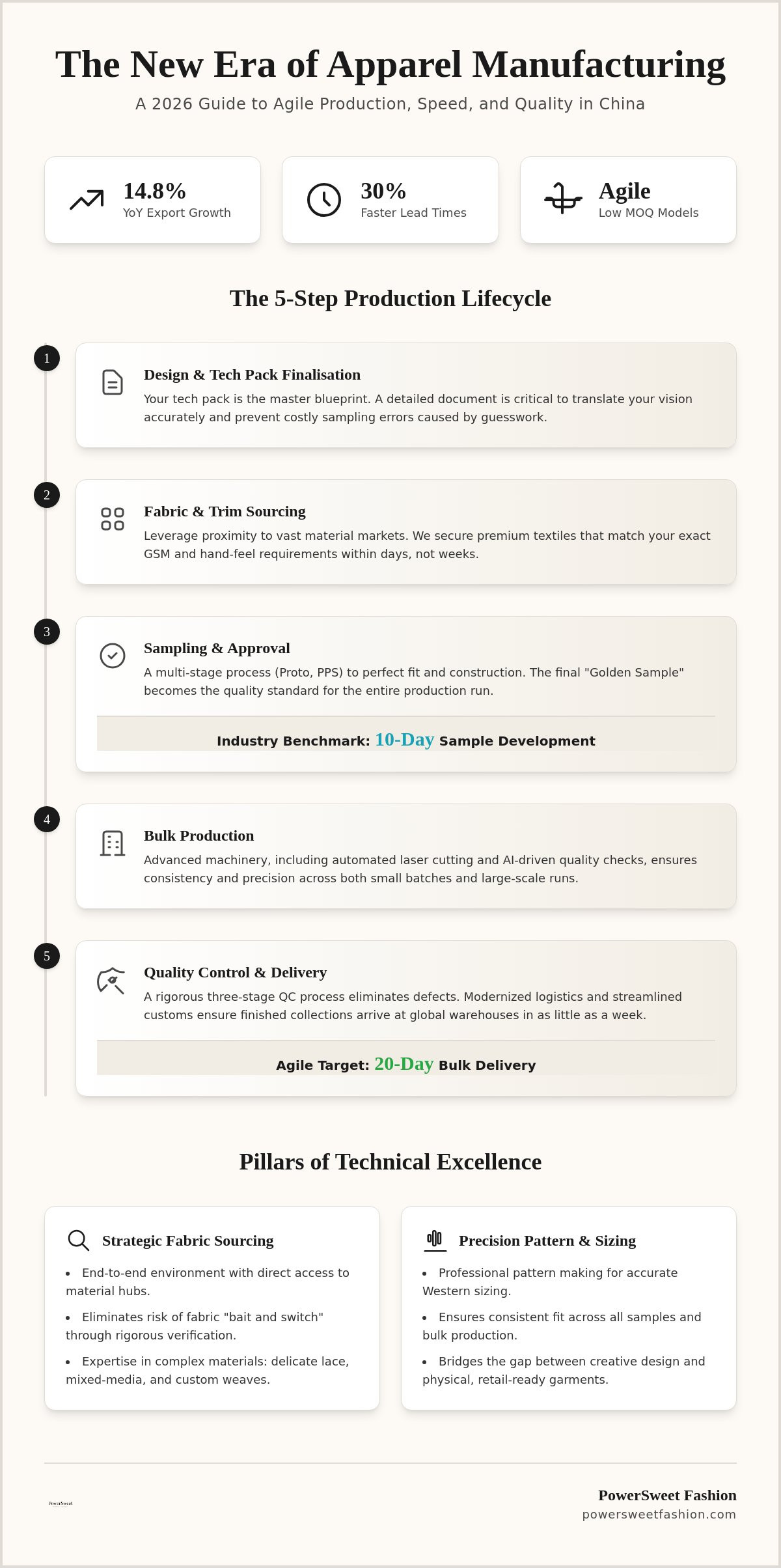
Vertical integration is the backbone of the modern Chinese factory. In specialized garment hubs, every component of a piece is accessible within a small geographic radius. This physical proximity to fabric markets and trim suppliers typically reduces lead times by 30% compared to fragmented supply chains where materials must be imported across borders. Advanced machinery, including automated laser cutting and AI-driven quality checks, ensures that consistency remains high across both small batches and bulk runs. It's a system where the transition from raw yarn to a finished, retail-ready garment is seamless and systematic.
Overcoming the Distance: Digital vs. Physical Transparency
Distance is no longer a barrier to rigorous quality control. By 2026, technology allows brand owners to monitor production in real-time through digital portals and live factory updates. We advocate for an "open-door" policy that invites international clients into the process, whether through virtual tours or physical visits. This transparency is reinforced by professional B2B project managers who act as the essential bridge between design intent and factory execution. They translate complex technical specifications into physical reality, ensuring that communication gaps don't lead to costly sampling errors or incorrect fabric choices.
The 5-Step Lifecycle of Garment Production in China
Moving from a creative concept to a retail-ready collection requires a disciplined sequence of events. While manufacturing clothing in China has become significantly faster in 2026, success still depends on adhering to a proven industrial lifecycle. It's not just about sewing. It's about technical validation at every stage. This process ensures that your creative vision survives the transition into a physical product without losing quality or fit accuracy.
The journey begins with Phase 1: Design Consultation and Tech Pack finalisation. Your tech pack is the blueprint for your brand. If it lacks detail, the factory is forced to guess, which leads to incorrect samples. Phase 2 involves sourcing the right fabrics and trims from local markets. The strategic industrial shift encouraged by the Made in China 2025 policy has pushed factories toward higher technical standards and better material access. This allows us to secure premium textiles that match your exact GSM and hand-feel requirements within days rather than weeks.
Mastering the Sampling Phase
Speed is the currency of modern fashion. A 10-day sample turnaround is now the industry benchmark for brands that need to stay ahead of trends. During this phase, you'll typically review a proto-sample first to validate the basic silhouette and fit. Once the fit is perfected, we move to the pre-production sample (PPS), which uses the actual bulk fabric and trims. The Golden Sample is the final, approved version that serves as the binding contract for quality and construction for the entire bulk run. Getting this right is essential before the assembly line begins to move.
Bulk Production Timelines and Expectations
Once the Golden Sample is signed off, the bulk production window typically spans 15 to 20 days. This is where assembly line management becomes critical. Factories must manage different fabric complexities, such as delicate silks or structured linens, within a single run while maintaining perfect consistency. Ensuring end to end clothing production remains seamless requires constant oversight. After assembly, the garments enter Phase 5: Final Quality Control and international logistics. If you're looking to refine your initial designs, our team offers specialized sample development to ensure your first production run is flawless.
Technical Excellence: Fabric Sourcing and Pattern Making
Technical precision in manufacturing clothing in China starts long before the first stitch is sewn. It begins with a deep mechanical understanding of textiles. For women's fashion, where drape and texture are paramount, sourcing the right material is a logistical challenge that requires local expertise. The ongoing transformation of clothing manufacturing has created a market where high-performance fabrics like Lyocell, Tencel, and premium Crepe are readily available. However, finding these materials is only half the battle. You must also verify their technical properties to ensure they perform under bulk production conditions.
Sourcing Quality Materials
Verification is the only way to avoid the "bait and switch" fabrics that brands often fear. We focus on verifying the fabric weight (GSM) and fiber composition before production starts. A dedicated sourcing team is essential for this. They don't just find materials; they hunt for "on-trend" textiles that meet specific brand aesthetics while ensuring technical stability. One common pitfall is dye-lot inconsistency. If you don't secure the entire fabric run at once, your bulk production might show subtle color shifts between batches. By 2026, sustainable sourcing has also become a standard requirement. We help brands access GRS-certified recycled polyesters and organic cottons that meet international compliance standards.
Pattern Making and Sizing Precision
Translating a 2D sketch into a 3D garment requires high-fidelity pattern making. This is where many brands struggle, especially when adapting designs for Western sizing. Professional pattern makers ensure that the proportions are correct for your target market. Precision at this stage directly impacts your bottom line. Accurate patterns reduce fabric waste during the cutting process, which lowers your overall production costs. Consistency is the goal. Whether you're producing a silk blouse or a structured blazer, the fit must remain uniform across the entire collection. This level of detail transforms a generic sample into a premium retail product.
Don't overlook the "trims." Buttons, zippers, and custom labels often define the final perceived value of your brand. Using high-quality YKK zippers or custom-branded hardware signals to your customer that you haven't cut corners. These small components are the final touch in achieving technical excellence. When you combine precise patterns with verified materials, the result is a collection that feels intentional and high-end.
Vetting Your Partner: Quality Control and Factory Transparency
Trust in manufacturing clothing in China isn't built on digital promises; it's earned through physical evidence and rigorous oversight. As the industry moves toward higher technical standards in 2026, vetting a partner requires looking beyond a website. You need a partner that operates with "Open-Door Transparency." This means they invite you into the process rather than keeping the factory floor shrouded in mystery. Reliable production depends on a 3-stage Quality Control (QC) process: Inline, Mid-line, and Final inspection. Each stage acts as a filter to catch errors before they compound into a failed bulk run.
Vetting also involves verifying international certifications. Look for ISO 9001 for quality management systems and BSCI (Business Social Compliance Initiative) for ethical labor standards. These aren't just badges; they're empirical evidence that the facility adheres to global compliance requirements. Direct communication with the production team is equally vital. When you can speak directly to the project manager overseeing your assembly line, the risk of "lost in translation" errors drops significantly. This human element turns a distant vendor into a pragmatic industrial partner.
The QC Checklist for Womenswear
Womenswear requires specific technical checks that generic QC often misses. We focus on stitching density (measured in stitches per inch), seam strength, and the specific drape of the fabric. A minor tension issue on a silk blouse can ruin an entire batch. You should always review a detailed QC report before any goods leave the facility. A credible custom women’s clothing manufacturer should provide photographic evidence of QC at every stage of the process. This documentation ensures that the "Golden Sample" you approved is the exact product being packed for shipment.
The Importance of Factory Visits
Meeting the production team in person changes the partnership dynamic from a transaction to a joint venture. During a factory walkthrough, focus on the physical reality of the workspace. Check for cleanliness, organized material storage, and the condition of the machinery. These details reflect the meticulous care the factory will apply to your garments. For global brands unable to travel in 2026, virtual tours provide a viable alternative. High-definition, real-time video walkthroughs allow you to inspect the assembly line and verify worker conditions from your office. If you're ready to secure your supply chain with a transparent partner, explore our Quality Control Services to ensure your brand standards are met every time.
Scaling with PowerSweet: Low MOQs and Agile Production
Scaling a brand requires a partner that understands the financial realities of growth. High Minimum Order Quantities (MOQs) are often the primary reason new fashion labels fail. They tie up essential capital in inventory that hasn't been market-tested, creating a high-risk environment for startups. By choosing a partner specializing in low-MOQ manufacturing clothing in China, influencer and boutique brands can launch smaller, diverse collections to gauge audience resonance. This agile approach minimizes upfront risk while leaving room for rapid expansion when a specific style goes viral.
We provide the engine for this transition. Moving from a startup brand to a global fashion powerhouse isn't just about finding a factory; it's about securing a supply chain that grows with you. Our end-to-end support covers every technical hurdle, from initial material sourcing and professional pattern making to final quality control and retail-ready packaging. This systematic approach ensures that as your order volume increases, your garment quality remains consistent and your brand identity stays intact.
Flexible Manufacturing for Modern Brands
Modern fashion moves at the speed of social media. Influence and boutique brands need to balance small-batch agility with the capacity for massive scale. Flexible manufacturing isn't just about small numbers; it's about the factory's ability to pivot. We provide extensive customization options even at lower production volumes, allowing you to maintain unique brand details without the burden of excessive stock. This flexibility allows you to:
Test new silhouettes and fabrics with minimal financial commitment.
Respond to real-time sales data by re-ordering top-performing styles quickly.
Maintain a lean inventory model that reduces waste and improves cash flow.
Scale production seamlessly as your brand gains market traction.
Your Partnership with PowerSweet Fashion
Our commitment to transparency and meticulous garment construction is what sets us apart as a pragmatic industrial partner. We don't just execute orders; we facilitate your brand's growth by acting as a "safe pair of hands" for your creative vision. The PowerSweet advantage is built on speed and reliability. Our streamlined system ensures 10-day sample development and 20-day bulk delivery, keeping your inventory fresh and your seasonal launches on schedule.
Our local supply chain expertise becomes your competitive advantage. By leveraging our deep connections in the textile markets, we secure premium materials that meet your technical specifications and sustainability goals. We invite you into the process, providing the transparency and data-driven reliability you need to scale with confidence. It's time to bridge the gap between digital design and physical reality. Ready to start? Contact our team for a design consultation today and let's build your next collection together.
Future-Proof Your Brand with Agile Production
The landscape of manufacturing clothing in China has shifted toward a model of high-speed precision and radical transparency. You now have the roadmap to navigate the technical lifecycle, from perfecting the "Golden Sample" to implementing a rigorous three-stage quality control process. Success in 2026 depends on moving beyond generic vendors and choosing a partner that understands the specific complexities of custom women's apparel. By prioritizing agile production and low MOQs, you can scale your creative vision without the burden of excessive inventory or disruptive lead times.
We provide the stability and speed necessary to turn your designs into a market-ready reality. Our system is built for brand owners who demand meticulous construction and empirical reliability at every stage. We bridge the gap between digital concepts and physical products by acting as your dedicated industrial engine. Start your production journey with PowerSweet Fashion to experience the advantage of samples ready in 10 days and bulk production completed in 15 to 20 days. Your brand's growth is no longer limited by traditional manufacturing barriers; it's time to build your legacy with a partner you can trust.
Frequently Asked Questions
Is it still cheaper to manufacture clothing in China in 2026?
Manufacturing clothing in China remains the most cost-effective option for brands requiring high-tech fabric integration and industrial scale. While average salaries for textile workers are approximately ¥66,759 as of July 2026, the real value lies in the country's unparalleled infrastructure. You benefit from a "one-stop" ecosystem where sourcing and assembly happen in a single hub, significantly reducing the indirect costs associated with fragmented global supply chains.
What is the typical minimum order quantity (MOQ) for Chinese factories?
Typical MOQs vary significantly depending on the factory's specific business model. Traditional mass-production facilities often require 500 to 1,000 pieces per style to maintain efficiency. However, agile partners now offer much lower MOQs, sometimes as low as 50 to 100 units, to support influencer and boutique brands. This flexibility allows you to test new designs without committing excessive capital to untested inventory during a seasonal launch.
How long does it take to get a sample from a Chinese manufacturer?
You should expect a 10-day turnaround for a professional sample in the current 2026 landscape. This timeframe includes technical pattern making and initial sourcing for your proto-sample. Speed is essential for staying ahead of viral fashion trends. Once you approve the proto-sample, the pre-production sample follows to ensure the bulk run matches your exact technical specifications for fit and fabric hand-feel.
Can I visit the factory in China to inspect my production run?
Yes, we actively encourage factory visits to maintain our commitment to "Open-Door Transparency." Meeting the production team in person provides a deeper understanding of the meticulous care applied to your garments. If travel isn't feasible, we offer high-definition virtual tours as a modern alternative. These real-time video walkthroughs allow you to inspect the assembly line and verify worker conditions from any global location.
How do I ensure my designs are protected when manufacturing in China?
Protecting your intellectual property requires a combination of legal contracts and vetted partnerships. You should always use a China-centric NNN (Non-Disclosure, Non-Use, Non-Circumvention) agreement before sharing your tech packs. Working with an established manufacturer that values long-term B2B partnerships is the most effective way to ensure your proprietary designs remain secure throughout the entire production cycle from concept to delivery.
What documents do I need to provide to start clothing production?
You must provide a comprehensive Tech Pack to begin the production process. This document should include technical sketches, a Bill of Materials, detailed sizing charts, and branding assets like labels or hangtags. A precise Tech Pack eliminates ambiguity and prevents the factory from making guesses that could lead to costly sampling errors. Clear documentation is the foundation of a successful and predictable manufacturing partnership.
How is quality control handled for overseas clothing orders?
Quality control for overseas orders is managed through a rigorous 3-stage inspection process: Inline, Mid-line, and Final. Each stage serves as a technical filter to catch construction errors before they reach the packaging phase. We provide detailed reports and photographic evidence to maintain transparency. This meticulous oversight ensures that manufacturing clothing in China consistently meets your brand's specific requirements for stitching density and seam strength.
Do Chinese manufacturers help with fabric and trim sourcing?
Yes, professional manufacturers provide integrated fabric and trim sourcing to streamline your production journey. Our teams leverage local supply chain expertise to secure "on-trend" textiles and high-quality hardware like YKK zippers. This proximity to raw material hubs is a major logistical advantage. It allows us to verify fabric weight and composition immediately, ensuring your bulk production remains consistent with the approved Golden Sample.


Comments