%20(1).png)
How We Make Sure Bulk Production Matches the Approved Sample
- Powersweet Team

- 2 days ago
- 14 min read
The factory approved your sample. You signed off on every seam, every measurement, every shade of fabric. Then the bulk order arrived, and something was wrong. The collar sits differently. The colorway has shifted. The fit that made your prototype perfect has somehow disappeared across 1,000 units. If this scenario feels familiar, you already know the real cost of a production gap: unsellable inventory, strained supplier relationships, and the sinking feeling that you didn't have the technical language to prevent it.
You're right to be frustrated, and you're not alone. Ensuring bulk production matches the approved sample is the single most critical challenge in scaling a garment line, and most brands only discover their process is broken after the damage is done.
The good news is that consistency at scale isn't a matter of luck. It's the result of treating your pre-production sample as a sealed technical contract, one that governs every machine setting, fabric cut, and quality checkpoint on the factory floor. In this article, we'll walk you through the exact protocols and quality control steps that keep bulk production locked to your approved standard, from pattern documentation and in-line inspections to final AQL checks before your order ships.
Table of Contents
The Golden Standard: Why Bulk Production Must Match the Approved Sample
Think of your approved sample not as a prototype, but as a legal document. Every stitch, every measurement, every fabric handle recorded in that sample represents a binding standard that your factory is contractually obligated to replicate across every unit in the bulk run. When that standard is blurry, production decisions get made by default rather than by design, and the results are predictable: inconsistency, waste, and a conversation you don't want to have with your retail buyer.
Ensuring bulk production matches the approved sample isn't just a quality aspiration. It's a structural discipline that has to be built into the process before a single piece of fabric is cut for production.
The Role of the Pre-Production (PP) Sample
The PP sample is the technical benchmark for the entire bulk run. Its purpose is fundamentally different from earlier development samples. Where fit samples and salesman samples exist to explore and sell, the PP sample exists to confirm. It must be produced using the actual bulk fabric, the confirmed trims, and the finalized construction methods that will be used on the production floor. Anything less and you're approving a simulation, not a standard.
Once the PP sample is signed off, it triggers the factory's "Go" signal for full-scale cutting and sewing. That approval is the final checkpoint in a chain of quality control principles in manufacturing that separates professional production from guesswork. If the PP sample doesn't reflect real bulk conditions, that checkpoint becomes meaningless.
Risks of Bypassing the Final Approval
The most common and costly mistake brands make is allowing a salesman sample, or even an early fit sample, to function as production guidance. Salesman samples are built for presentation. They're often sewn by a single skilled machinist using premium fabric substitutes, under conditions that don't reflect a factory's standard workflow. Using one as a production reference is like asking a chef to replicate a dish they've never actually cooked.
What follows is a phenomenon known as "sample drift": small, seemingly minor deviations in the sample phase that compound into significant bulk variations. A collar that sits 4mm higher. A seam allowance trimmed slightly narrower to save time. A fabric that looks identical on screen but behaves differently under industrial pressing. None of these feel catastrophic in isolation. Across 1,000 units, they define the difference between a sellable product and a return pile.
There's also a persistent misconception that "minor" fit adjustments can be communicated verbally or through email annotations. They can't. Every change, no matter how small, requires a revised physical sample and a fresh approval cycle. Skipping that step is where bulk disasters begin.
The distinction between commercial acceptability and exact replication matters here. Exact replication is the goal; commercial acceptability is the minimum threshold. A unit that passes commercial acceptability might reach your customer, but it won't build the brand consistency that drives repeat purchases and wholesale confidence. The PP sample, treated as a sealed contract rather than a loose reference, is what keeps production anchored to the higher standard.
Technical Factors That Cause Bulk Production Variations
Knowing that bulk production can drift from your approved sample is one thing. Understanding exactly why it drifts is where you gain the ability to prevent it. The gap between a perfect PP sample and a compromised bulk run almost always traces back to four predictable technical variables: material inconsistency, machine calibration, human variability, and fabric behavior under industrial handling. Each one is manageable. None of them are inevitable.
Dye Lot and Material Consistency
Color is the most visible failure point in bulk production, and it's also the most misunderstood. Fabric dyed in separate batches, even from the same mill using the same formula, will produce measurable color differences. This is the dye lot problem, and it's structural, not accidental.
The professional solution is the lab dip process. Before bulk fabric is approved, the factory's dye house produces small test swatches, lab dips, matched against a physical color standard under standardized lighting conditions. Approving a lab dip that's "close enough" is how subtle colorway shifts enter your bulk run. Approval should be conditional on an exact match under at least two light sources, typically D65 daylight and TL84 store lighting, to catch metamerism, the phenomenon where colors match in one light and diverge in another.
Fabric roll width is a separate but equally critical issue. If bulk rolls arrive narrower than the rolls used during sample cutting, your marker efficiency drops and your grain line placement shifts. That shift changes how the fabric drapes, stretches, and presses. It's one reason why end-to-end clothing production reduces material surprises: when sourcing and production are managed under one roof, fabric specifications are locked before cutting begins, not discovered after the fact.
Machine Settings and Production Speed
A sample room machinist works slowly, deliberately, and often on a single specialized machine. The production floor operates on speed and volume, running multiple machines simultaneously, each requiring individual calibration. Stitch-per-inch (SPI) settings that weren't documented from the sample room become judgment calls on the line. Those judgment calls introduce variation.
Heat-press and bonding settings present a similar risk. The temperature and dwell time used to bond interfacing in a sample can't simply be assumed to transfer to bulk. Different fabric weights and batch compositions respond differently under industrial pressing, and re-testing these parameters for each bulk run is non-negotiable. Brands that skip this step often find fusing delamination or collar roll inconsistencies at final inspection.
Specialized templates solve the placement problem. Pocket positioning, trim attachment points, and label placement should all be governed by hard templates, not a machinist's eye. This is where manufacturing quality standards become operationally relevant: process controls that remove human estimation from repeatable tasks are the foundation of consistent output at scale. When ensuring bulk production matches the approved sample is the objective, templates aren't optional; they're the mechanism that makes consistency reproducible across every operator on the line.
The human element compounds all of the above. A single skilled machinist built your sample. Dozens of operators, each with slightly different technique, tension habits, and speed settings, will build your bulk order. Without standardized work instructions tied directly to the PP sample's construction methods, variation is the default outcome, not the exception. If you're evaluating manufacturing partners, it's worth asking how their production teams are briefed on sample-specific construction requirements before the first unit is cut.
Structural Safeguards: Tech Packs and Sealed Samples
Documentation is the infrastructure of consistency. Once the technical variables are understood, the next step is building the physical and paper-based systems that keep every operator, every machine, and every quality checkpoint anchored to a single, non-negotiable standard. Two tools do this better than anything else: the final tech pack and the sealed sample. Together, they form the structural backbone that ensures bulk production matches the approved sample, not approximately, but exactly.
The Final Tech Pack as the Production Bible
A tech pack's value isn't static. It's a living document that must be updated after every sample iteration, and a sample development clothing manufacturer that doesn't revise the tech pack after each round of corrections is leaving the production floor to interpret changes from memory. That's where errors enter the system.
The final tech pack issued before bulk cutting should include:
A fully reconciled Bill of Materials (BOM) listing the exact bulk trims, threads, labels, and interlining, confirmed by supplier lot numbers where available
Detailed construction notes specifying seam types, stitch types, finishing methods, and pressing sequences for each garment panel
Labeling and packaging instructions tied to the confirmed bulk units, not the sample room prototypes
Defined Points of Measure (POM) with tolerance ranges for every critical measurement, from chest width and sleeve length to hem circumference and collar stand height
POMs are particularly important. Every measurement listed in the tech pack becomes an auditable checkpoint during inline and final inspections. Without defined tolerances, a supervisor can only make a judgment call. With them, pass or fail is objective.
The Sealed Sample System
Digital files don't stop a machinist from making a small adjustment. A physically sealed, signed, and dated garment does.
The sealed sample protocol works like this: once the PP sample is approved, two identical units are produced from that exact approval state. One becomes the Gold Sample, stored on the factory floor as the daily physical reference for line supervisors and QC inspectors. The second becomes the Counter Sample, retained by the brand as the contractual benchmark for dispute resolution.
On the production floor, a color-tag system reinforces the standard. Green tags identify approved PP units that meet the sealed sample criteria. Red tags flag rejected units and must be accompanied by a written defect description before they leave the line. This isn't bureaucracy; it's a feedback loop that catches pattern problems before they replicate across hundreds of units.
The most critical window in any bulk run is the first 50 units. Side-by-side comparisons between these early production pieces and the Gold Sample should be mandatory. Fit, construction, and colorway are all assessed together, under consistent lighting, before the full line accelerates to speed. Catching a 3mm collar deviation at unit 40 costs nothing. Catching it at unit 800 costs everything.
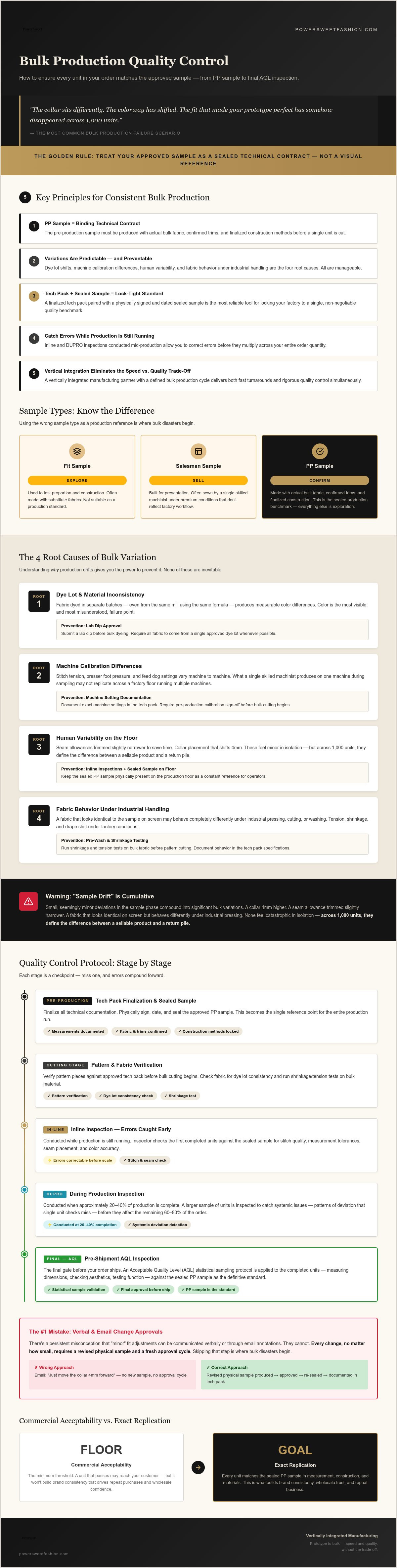
Quality Control Protocols During the Bulk Manufacturing Phase
Documentation and sealed samples set the standard. What happens on the production floor determines whether that standard is actually met. Quality control during bulk manufacturing isn't a single checkpoint at the end of the line; it's a layered sequence of inspections designed to catch deviations at the earliest possible moment, when correction is still cheap and fast.
Three inspection stages define a professional bulk QC process: inline inspections, DUPRO checks, and the Final Random Inspection. Each one serves a distinct function, and skipping any of them shifts the risk from the factory floor to your finished inventory.
Inline inspections happen while garments are still on the needle. A line supervisor or QC inspector moves through the active sewing stations, checking individual operations against the Gold Sample and the tech pack's Points of Measure. This is where the human element in manufacturing matters most. A single machinist developing a tension habit, or a pressing station running slightly hot, produces a defect pattern that compounds with every unit completed. Catching it at the inline stage means correcting one operator's process. Missing it means reworking hundreds of finished garments.
DUPRO checks occur at the 20-30% completion mark, once a meaningful sample of finished units can be pulled and assessed together. At this stage, inspectors are looking not just at individual garments but at consistency across the batch: colorway uniformity under standardized lighting, measurement variance across size runs, and construction quality relative to the sealed sample. A DUPRO check is the last practical opportunity to course-correct before the bulk run accelerates to full speed.
The TOP Sample: Your First Bulk Look
Before the order is packed, brands should request a Top of Production (TOP) sample: the first fully finished unit off the bulk line, complete with packaging, folding, hangtags, and labels. This unit is assessed side-by-side against the approved PP sample to confirm that ensuring bulk production matches the approved sample has been maintained through to the final packed state. Minor discrepancies found at this stage, a hangtag positioned incorrectly or a polybag fold that compresses a structured collar, are corrected before packing instructions are issued across the full order.
AQL Standards and Final Audits
The Final Random Inspection uses AQL (Acceptable Quality Level) sampling to audit the packed order before shipment. For women's fashion, AQL 2.5 is the standard applied to major defects; some brands apply AQL 4.0 for minor cosmetic issues. Defects are classified across three tiers:
Critical defects: Safety or regulatory failures that make a unit unsellable under any condition
Major defects: Visible construction or measurement failures that a customer would reject at point of purchase
Minor defects: Small cosmetic variations that don't affect function or appearance at normal viewing distance
The value of working with a custom women's clothing manufacturer that permits third-party inspections can't be overstated. An independent inspector carries no incentive to pass a borderline unit. That objectivity is what makes the FRI a genuine quality gate rather than a formality. If your manufacturing partner restricts third-party access, that restriction itself is a risk signal worth taking seriously.
Ready to build a QC process that protects your bulk order from first cut to final pack? Talk to the PowerSweet Fashion production team about how our end-to-end quality control services are structured around your approval standards.
PowerSweet Fashion: Reliability from Prototype to Bulk
At PowerSweet Fashion, we don't treat quality control as a final hurdle. We treat it as the engine of our production line. Our entire infrastructure is designed to ensure that Bulk Production Matches the Approved Sample, regardless of the order's complexity or scale. We provide the technical stability that fashion brands need to grow, acting as a pragmatic industrial partner that prioritizes reliability over abstract promises.
Our integrated supply chain is the reason we can offer a 15-20 day bulk production cycle without sacrificing the rigorous QC protocols required for high-end apparel. Because we manage fabric sourcing and pattern making in-house, we eliminate the communication gaps that typically lead to material surprises. Our dedicated pattern makers don't just create a single size; they translate the intricate sample fit into precise mass production grading. This ensures the silhouette you approved in a size small remains consistent across your entire size run, from the first unit to the last.
Speed and Precision in Women's Apparel
We've optimized our 10-day sample turnaround to allow for rapid iteration. This speed gives brands the breathing room to refine their PP sample until it's perfect, rather than settling for a compromised prototype due to tight deadlines. We specialize in the technical complexities of women's fashion, particularly when working with challenging materials like Lyocell and Crepe. These fabrics require specific machine tension settings and handling techniques that our teams have mastered at scale. As a low MOQ women's clothing manufacturer, we apply boutique standards to every order. We prove that smaller production runs don't have to mean lower technical precision or inconsistent quality.
The PowerSweet Partnership Model
We believe in transparency throughout the manufacturing journey. We invite our partners into the process, offering factory visits that serve as the ultimate tool for oversight and trust. This direct line of communication with the production team is the most effective way to prevent "Sample Drift." You aren't just sending a tech pack into a void; you're entering a collaborative venture where our seasoned team executes your vision with empirical reliability. In the fast-paced fashion environment of 2026, this stability is the most valuable asset a manufacturer can provide. We act as a safe pair of hands, ensuring your capital is invested in sellable, high-quality inventory that perfectly mirrors your signed-off prototype.
Securing Your Production Future Through Technical Discipline
Success in garment manufacturing isn't found in the design alone; it's found in the execution. By treating your pre-production sample as a technical contract and implementing a layered inspection strategy, you eliminate the guesswork that leads to sample drift. You've learned that ensuring Bulk Production Matches the Approved Sample requires more than hope. It requires documented tech packs, sealed physical benchmarks, and a commitment to catching errors while they're still on the needle. These safeguards turn a volatile process into a repeatable, industrial system.
PowerSweet Fashion provides the infrastructure to make this level of precision a reality for your brand. We combine specialized women's wear expertise with a 10-day sample turnaround and a 15-20 day bulk production cycle. This speed doesn't come at the expense of quality; it's the result of a streamlined, transparent system designed to protect your creative vision and your capital. We act as your pragmatic industrial partner, providing the stability you need to scale without the risk of unsellable inventory.
Ready to start your production? Contact PowerSweet Fashion for a quote today.
We're ready to help you build a consistent, high-quality collection that your customers can trust.
Frequently Asked Questions
What is the difference between a proto sample and a pre-production sample?
A proto sample is an early exploratory garment, often sewn in a substitute fabric, used to test the design concept and basic fit. It's a starting point, not a standard. A pre-production (PP) sample is the final confirmation stage: it must be produced using the actual bulk fabric, confirmed trims, and the exact construction methods that will run on the production floor. Approving a proto as a production reference is one of the most common and costly mistakes a brand can make.
Can I skip the sampling phase if my tech pack is perfect?
No. A tech pack, however detailed, is a set of instructions. It can't account for how your specific bulk fabric behaves under industrial pressing, how your chosen trims interact with the base material, or how machine tension on a production line differs from a sample room. The PP sample is the physical proof that the instructions translate correctly into a finished garment. Skipping it removes your only opportunity to catch translation errors before they replicate across the entire bulk run.
Why does the bulk fabric feel slightly different from the sample fabric?
This is a common issue and it usually comes down to dye lot variation, finishing treatments, or fabric sourced from a different mill batch. Even fabric ordered from the same supplier can behave differently between batches due to changes in fiber composition or finishing chemistry. The solution is to approve bulk fabric swatches against the original sample fabric before cutting begins, not after. If your manufacturer sources fabric in-house as part of an end-to-end service, this comparison happens before the bulk roll ever reaches the cutting table.
What should I do if bulk production doesn't match my approved sample?
Stop production immediately and document every deviation with photographs alongside the sealed sample and the relevant tech pack measurement. Classify each issue as critical, major, or minor, then issue a formal defect report to your factory contact with a written correction request. Don't accept verbal reassurances. Require a corrected physical unit before the production line resumes. If the deviation is significant, a partial rework or re-cut may be necessary, and your counter sample becomes the contractual reference for any dispute resolution.
How many sample rounds are typically needed before bulk production starts?
Most garments require two to four sample rounds before a PP sample is ready for approval. Simple, well-documented styles with clear tech packs can reach approval in two rounds. Complex constructions involving structured elements, intricate seaming, or technically demanding fabrics like Lyocell or Crepe often need three or more iterations to resolve fit, construction, and material behavior. The goal is always a PP sample that's genuinely production-ready, not one that's "close enough" to move forward on a deadline.
What is a 'Sealed Sample' and why is it important for quality control?
A sealed sample is a physically signed and dated garment produced from the exact approved PP sample state. Two units are created: a Gold Sample that lives on the factory floor as the daily reference for line supervisors and QC inspectors, and a Counter Sample retained by the brand as the contractual benchmark. This system ensures that ensuring bulk production matches the approved sample isn't left to memory or digital files. A machinist can't argue with a garment hanging next to their workstation.
Does a low MOQ manufacturer offer the same bulk consistency as large factories?
It depends entirely on the QC infrastructure, not the order size. A low MOQ manufacturer that runs structured inline inspections, uses sealed samples, and applies defined Points of Measure to every batch can deliver the same consistency as a high-volume facility. Order size alone doesn't determine quality discipline. What matters is whether the factory applies the same technical protocols to a 200-unit run as it does to a 2,000-unit run, and that's a question worth asking directly before you commit.
How does the 'TOP' sample differ from the 'PP' sample?
The PP sample is approved before bulk cutting begins and sets the production standard. The TOP (Top of Production) sample is the first fully finished unit pulled from the completed bulk run, packed with all final trims, hangtags, labels, and folding exactly as it will ship. Its purpose is to confirm that the standard established at PP approval has been maintained all the way through to the final packed state. Finding a packaging or labeling error at the TOP stage costs almost nothing to fix. Finding it after 1,000 units are packed costs significantly more.


Comments