%20(1).png)
How to Switch Clothing Manufacturers: The Professional Guide to a Seamless Transition

Switching your production line isn't just a change of address; it's a strategic migration of your brand's most valuable intellectual property.
You've likely reached a breaking point where inconsistent garment quality or rising MOQs no longer align with your scaling strategy.
The process of switching clothing manufacturers often feels high-risk, especially when you're worried about losing proprietary patterns or experiencing a communication breakdown during the critical handoff phase.
It's a valid concern, as a single error in this transition can lead to costly stockouts or compromised designs that alienate your customer base.
We've developed this professional guide to ensure your transition becomes a catalyst for growth rather than a source of operational chaos.
You'll gain a systematic framework to migrate your women's apparel production while maintaining absolute quality control and inventory stability.
We'll cover everything from securing your technical documentation and tech packs to establishing faster sample turnarounds.
By following these transparent protocols, you can secure a reliable manufacturing partner that acts as a true extension of your creative team and provides a safe pair of hands for your brand's future.
Table of Contents
Why Fashion Brands are Switching Clothing Manufacturers in 2026
The "Performance Gap" often signals that your brand's trajectory has outpaced your factory's infrastructure.
This occurs when your need for higher precision or faster scalability is met with resistance from an outdated vendor.
In 2026, switching clothing manufacturers is a strategic decision to align with partners who support agile business models.
Many brands are moving away from restrictive, high Minimum Order Quantities (MOQs) that force them into heavy inventory risks.
Successful labels now rely on "test and repeat" collection models, where smaller initial runs allow for market validation before scaling up production.
This shift preserves your cash flow and ensures that your warehouse isn't filled with unsold inventory that no longer meets market trends.
Efficiency in the modern market is measured in weeks, not months.
A 15-20 day bulk production cycle has become the benchmark for brands that want to maintain a constant presence in front of their customers.
Achieving this speed requires a partner capable of end to end clothing production.
When fabric sourcing, sample development, and bulk manufacturing are handled by a single entity, the communication gaps that cause delays are naturally eliminated.
This integrated approach allows for a level of responsiveness that traditional, fragmented supply chains simply cannot match.
Recognizing the Red Flags in Your Current Supply Chain
Identifying the need for change starts with auditing your current results.
Consistent quality control failures are more than just an inconvenience; they're a threat to your customer loyalty.
You should also watch for "lead-time creep," where delivery dates slowly drift later into the season without a clear explanation.
Transparency is equally vital. If your vendor can't provide clear documentation on the textile production process or fabric origins, you're flying blind on compliance and quality assurance.
These issues rarely resolve themselves and typically worsen as your order volume increases.
The Strategic Advantage of Specialization
Generalist factories often lack the technical depth needed for high-end women's apparel, which is why many brands prioritize specialization when switching clothing manufacturers.
Choosing a specialized custom women's clothing manufacturer provides access to expert pattern makers who understand female silhouettes and fabric drape.
When a partner manages the entire journey from pattern making to the final stitch, fit consistency becomes a baseline rather than a gamble.
This level of specialization reduces the need for multiple sampling rounds, saving you time and resources while ensuring your creative vision is executed exactly as intended.
By partnering with a factory that owns the entire process, you gain a "safe pair of hands" that can handle complex construction without the risk of quality degradation.
Preparing Your Technical Documentation for a Seamless Migration
Successful production relies on data, not assumptions. A "Production Migration Audit" is the first step in switching clothing manufacturers without losing the nuances of your brand's fit and finish.
This audit is a rigorous review of your technical assets to ensure every specification is current and ready for a new production line.
Relying on an old factory's memory of your "usual" standards is a recipe for disaster.
You need a comprehensive digital and physical blueprint that allows any professional facility to replicate your garments with 100% accuracy.
Agile brands treat their documentation as a living asset rather than a static file.
By Optimizing Sourcing Through Agile Project Management, you can reduce the friction of vendor transitions.
This approach emphasizes clear communication and iterative verification throughout the supply chain.
When you provide a new factory with a complete technical package, you eliminate the guesswork that leads to sampling delays and production errors.
The Tech Pack Audit: Your Production Blueprint
Your Tech Pack must be an exhaustive instruction manual for the new team.
Start by updating your Bill of Materials (BOM) to include every current fabric supplier, thread weight, and trim specification used in your latest production run.
If you've made "on the floor" adjustments during previous runs to fix fit issues, these must be reflected in the digital measurement charts and grading rules.
Precision here prevents sizing drift. We recommend including high-resolution construction photos for complex details like hidden plackets or reinforced seams.
This visual clarity ensures the new team understands the internal architecture of your designs before they cut the first sample.
Pattern Migration and Digital Compatibility
Securing your intellectual property is paramount when switching clothing manufacturers. You must confirm that you own all proprietary patterns and digital grading files.
Converting these assets into industry-standard digital formats ensures that the new factory can begin work without needing to reverse-engineer your designs.
When you engage with professional pattern making services, they can verify that these files translate correctly across different CAD systems.
Establish a strict protocol for "First Fit" approvals to compare the new factory's output against your established Master Sample.
The "Master Sample" protocol is your final safeguard. You must provide the new team with a perfect physical reference of the garment they are expected to produce.
This isn't just a random piece from your inventory; it's a "gold standard" sample that has been vetted for every detail.
Having this physical reference allows the quality control team to perform side-by-side comparisons during the pilot run, significantly reducing the risk of a quality mismatch.
If you need assistance refining your technical files before the move, our team at PowerSweet Fashion can help streamline your documentation for a flawless transition.
Evaluating New Production Partners: Beyond the Price Tag
Cost is a significant factor, but it shouldn't be the primary driver when switching clothing manufacturers.
A lower unit price often masks hidden expenses such as high defect rates, missed shipping windows, or poor communication.
We advocate for the "Facilitator Framework," which prioritizes a factory's ability to act as a proactive partner in your supply chain.
A facilitator doesn't just wait for instructions; they identify potential production bottlenecks before they occur.
This collaborative approach is essential for maintaining the meticulous care your women's apparel requires during a vendor transition.
Responsiveness is the most reliable proxy for operational health. Use the "24-hour responsiveness test" during your initial outreach.
If a factory takes three days to answer a basic question about fabric sourcing or MOQs, they'll likely be even slower when a production crisis hits.
Reliable communication prevents delays and builds trust.
You must also verify their quality control clothing manufacturer protocols.
Ask for documentation on their in-line and final inspection processes. A transparent partner will welcome in-person factory visits or third-party audits to prove their commitment to your standards.
Finally, test the "Sample-to-Bulk" ratio by ensuring the final production run matches the approved prototype in every technical dimension.
The 10-Day Sampling Test
Speed in sampling is the best indicator of overall factory efficiency.
A 10-day turnaround for prototypes demonstrates that the facility has a streamlined workflow and immediate access to raw materials.
During this phase, evaluate the accuracy of the sample against the tech pack you audited in the previous stage of this guide.
If the initial prototype misses key construction details or uses the incorrect seam allowance, it suggests a lack of attention to detail that will only amplify during bulk production.
Use this sampling window to test their fabric sourcing capabilities and ensure the handfeel matches your brand's requirements.
Vetting for Women's Wear Expertise
Complex silhouettes require specialized machinery and deep technical knowledge.
Analyze the factory's portfolio specifically for garment complexity, such as structured dresses, delicate blouses, or intricate tops.
Inquire about their specific machinery for handling lightweight silks or stretch fabrics to ensure they can execute your designs without puckering or damage.
Using a quality control checklist during the vetting process helps you maintain a standardized evaluation across multiple candidates.
This systematic approach ensures that when switching clothing manufacturers, you are moving toward a "safe pair of hands" that understands the physical reality of high-end garment construction.
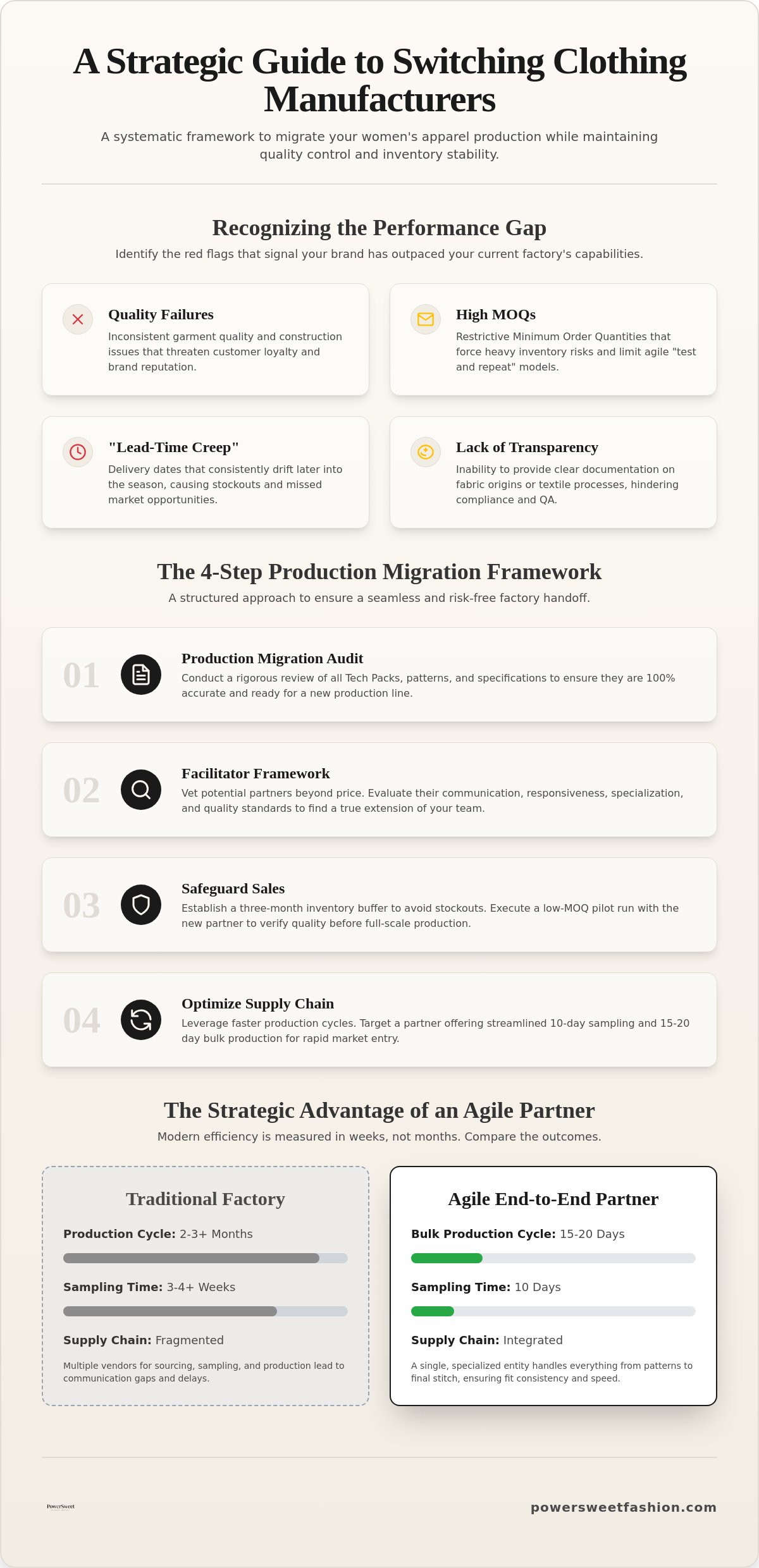
The Step-by-Step Transition Timeline: Avoiding Stockouts
A gap in your supply chain is a direct hit to your revenue. When switching clothing manufacturers, the goal is to maintain a continuous flow of product while you calibrate the new production line.
This requires a transition timeline that prioritizes risk mitigation over speed.
You shouldn't simply stop production at one facility and hope the next one hits the ground running. Instead, treat the move as a phased migration that overlaps both partners until the new vendor proves their reliability.
Phase 1 begins with building an inventory buffer.
You need enough safety stock to cover at least three months of sales. This window allows for sampling, pilot runs, and any shipping delays that might occur during the handoff.
Phase 2 introduces the Pilot Run, where you test the new line with a low-volume order.
Phase 3 is the critical "Overlap" period.
During this stage, you run parallel production at both factories. You only scale down the old factory once the new partner consistently hits 100% quality control pass rates.
Finally, Phase 4 is the Full Migration, where you move your entire SKU library to the new facility.
Managing the Inventory Buffer
You must calculate your "Burn Rate" to determine exactly how much stock you need to weather the transition.
This is your average monthly sales volume multiplied by the expected migration window, typically three months.
Planning this shift during a "low season" is a tactical move that minimizes sales impact if the first samples require revision.
It's also vital to communicate the transition to your warehouse and logistics partners.
They need to prepare for new shipping origins and potentially different packaging dimensions to ensure a smooth intake process.
The Pilot Run Strategy
Selecting your most "stable" SKU for the first production run is a strategic choice. Don't lead with your most complex or experimental design.
Use a proven style with established patterns to test the factory's baseline execution and communication speed.
We recommend implementing 100% third-party inspection for the first three shipments.
This provides an objective data set to refine the communication flow and catch errors before they reach your customers.
If you are ready to begin this process with a partner that values precision, contact PowerSweet Fashion to discuss your transition plan.
The feedback loop during the pilot run is the most important part of the transition.
Use the data from your third-party inspections to have transparent conversations with the new production team.
This is the time to iron out any misunderstandings regarding seam finishes, label placement, or packaging requirements.
By starting small and scaling only after verification, you ensure that switching clothing manufacturers becomes a professional upgrade rather than a logistical disaster.
Scaling with PowerSweet Fashion: Your End-to-End Production Partner
Transitioning your brand to a new facility requires more than just a contract; it requires a partner that understands the mechanics of your growth.
When switching clothing manufacturers, the friction usually occurs in the translation of technical details.
PowerSweet Fashion eliminates this risk by acting as your dedicated industrial engine.
We specialize in custom women's clothing production, providing the infrastructure you need to scale without the typical growing pains of vendor migration.
Our facility in Guangzhou, China, operates with an open-door transparency policy, inviting you to oversee quality protocols firsthand and verify our physical production reality.
Speed is our primary currency.
We offer a 10-day sample turnaround and a 15-20 day bulk production cycle to keep your brand ahead of rapid market shifts.
These timelines are supported by a low Minimum Order Quantity (MOQ) of just 50 pieces per style.
This flexibility allows you to test new designs with minimal capital risk, effectively ending the "volume trap" that stalls many emerging labels.
By prioritizing responsiveness and precision, we ensure your transition is not just a change of vendor, but a strategic upgrade to your entire supply chain.
We are the safe pair of hands that creative directors rely on to turn concepts into market-ready inventory.
The PowerSweet Migration Process
We provide direct access to our in-house pattern making and fabric sourcing teams to ensure your creative vision is technically viable from day one.
Your dedicated account manager oversees the entire migration, ensuring that every detail in your tech packs is translated perfectly into our production workflow.
This eliminates the communication breakdowns that often plague the first few runs with a new partner.
Our quality control protocols are built on a zero-defect commitment specifically tailored for the complexities of modern women's fashion.
Partnering for Long-Term Growth
Our end-to-end services are designed to reduce your administrative overhead by centralizing the production journey.
Instead of managing multiple vendors for grading, sourcing, and sewing, you work with a single, accountable partner.
This streamlined approach allows you to focus on marketing and design while we handle the logistical heavy lifting.
We support your brand's evolution as you move from small-batch testing to global bulk production, maintaining the same level of meticulous care at every scale.
Switching clothing manufacturers is the first step toward a more resilient, agile business model.
Contact our team to begin your production audit today and secure a reliable future for your apparel line.
Securing Your Brand's Production Future
A successful vendor transition is a deliberate shift toward higher operational standards.
By auditing your technical documentation and implementing a phased migration strategy, you eliminate the risks that often accompany switching clothing manufacturers.
Remember that a reliable partner doesn't just execute orders; they facilitate your brand's growth through transparency and technical precision.
You've now seen how a structured timeline and a pilot run protect your inventory flow while you establish a new production baseline.
PowerSweet Fashion is ready to act as the safe pair of hands for your women's apparel line.
We provide the speed and reliability your business demands, featuring a 10-day sample turnaround and 15-20 day bulk production cycles.
Our Guangzhou factory is always open for in-person quality oversight visits, ensuring you have total visibility into our meticulous process.
We look forward to powering your creative vision with a streamlined, end-to-end manufacturing system that scales as fast as you do.
Frequently Asked Questions
How long does it typically take to switch clothing manufacturers?
A professional transition usually requires 3 to 6 months to execute properly.
This window allows for a thorough technical audit, multiple sampling rounds, and a low-volume pilot run to verify quality.
Starting the process at least one full season ahead of your target launch ensures you aren't forced to compromise on standards due to an impending deadline.
Will I lose my patterns if I leave my current factory?
You won't lose your patterns if you've secured ownership rights in your service agreement.
It's vital to collect all digital CAD files or physical master patterns before you notify your current vendor of the move.
If your factory originally developed the patterns, you might need to pay a release fee or have a professional pattern maker recreate them from your existing "gold standard" samples.
What is the biggest mistake brands make when switching manufacturers?
The most common error is failing to build a sufficient inventory buffer before starting the move.
Brands often cut ties with their old vendor before the new production line is fully calibrated, leading to costly stockouts.
When switching clothing manufacturers, always maintain a three-month safety stock to cover potential sampling delays or shipping hurdles during the handoff.
Can I switch manufacturers in the middle of a production season?
It's possible but carries significant risk to your brand's consistency.
Moving production during a peak season often results in "batch variance," where garments from the same collection look or fit differently.
We recommend waiting for a production lull to migrate your SKU library. This allows the new team to focus on technical accuracy without the pressure of an immediate seasonal launch.
How do I know if a new manufacturer is actually reliable?
Reliability is measured by responsiveness and technical transparency.
A trustworthy partner will consistently meet a 24-hour communication window and provide accurate prototypes within a 10-day sampling period.
You should also look for a factory that welcomes third-party inspections and provides clear documentation of their internal quality control protocols before you sign a contract.
Do I need to visit the new factory in person before switching?
In-person visits are highly recommended but not strictly mandatory if the factory provides digital transparency.
High-resolution video tours and third-party audit reports can provide peace of mind.
However, visiting a facility in a hub like Guangzhou allows you to see the physical reality of the production floor and build a direct partnership with the people handling your garments.
How do I handle fabric sourcing when moving to a new partner?
You have the option to transfer your existing suppliers or leverage the new factory's internal network.
If you use proprietary materials, you must provide the new manufacturer with the supplier's contact data and technical specifications.
Many brands prefer a partner with integrated fabric sourcing, as it reduces administrative overhead and ensures the factory takes full responsibility for the material's performance.


Comments