%20(1).png)
The Definitive Guide to Choosing a Clothing Line Production Partner in 2026

Updated: Jul 10
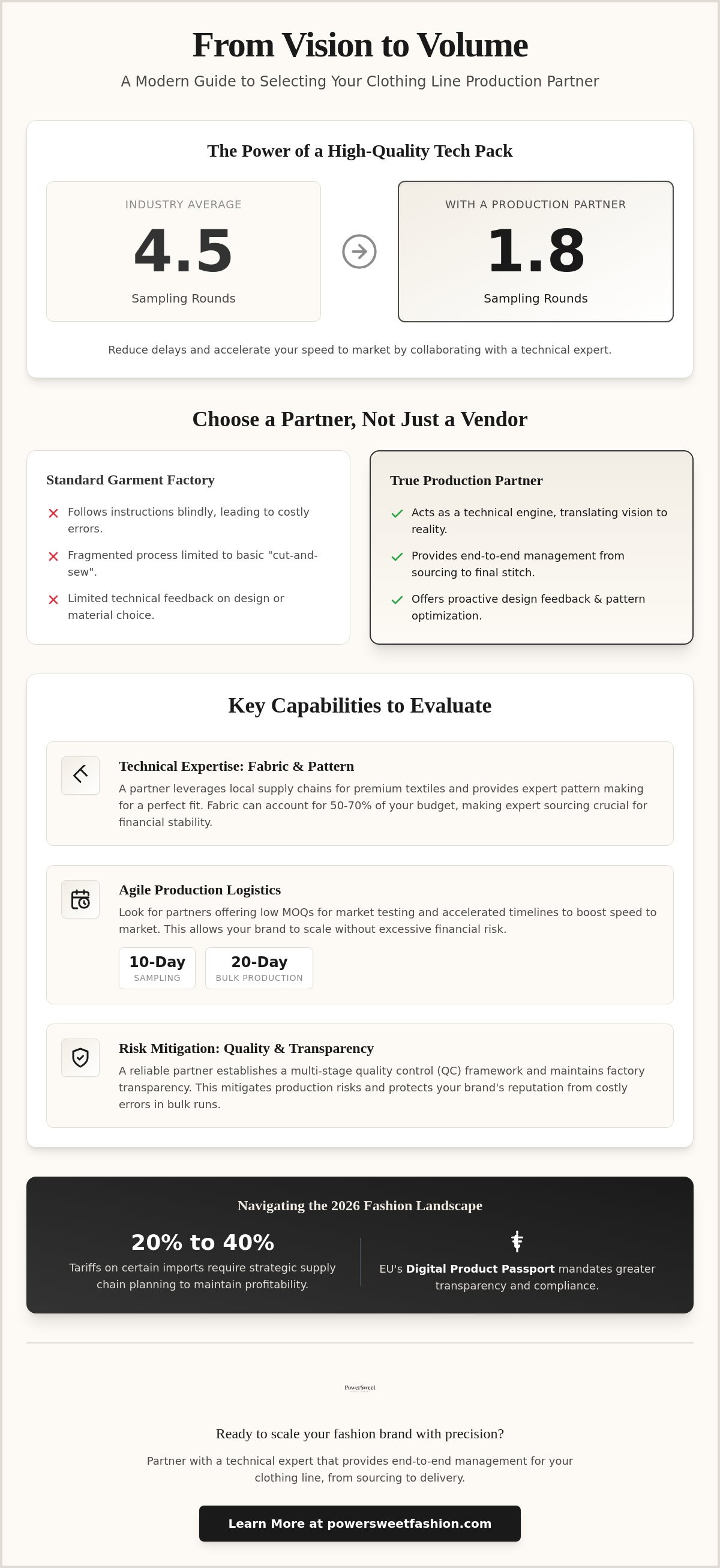
Did you know that a high-quality tech pack can reduce your average sampling rounds from 4.5 down to just 1.8? In 2026, where speed to market is the ultimate competitive advantage, your clothing line production partner acts as the technical engine of your brand. You've likely faced the anxiety of poor quality control in bulk runs or slow sample turnaround times that push your launch dates into the next season. It's frustrating to feel like your creative vision is stalled by logistical bottlenecks and high minimum order quantities that prevent you from testing the market with agility.
We understand that you need more than just a factory; you need a transparent collaborator that handles the heavy lifting of production. This guide will teach you how to identify, evaluate, and work with a manufacturing partner that scales your fashion brand with precision. We'll explore the impact of the EU's Digital Product Passport mandates, navigate the 20% to 40% tariffs on certain imports, and show you how to find specialized partners that offer lower MOQs for better brand experimentation. It's time to build a resilient supply chain that turns your concepts into commercial reality through a methodical, end-to-end approach.
Table of Contents
What is a Clothing Line Production Partner?
A clothing line production partner serves as the technical engine that translates your creative vision into a scalable commercial reality. In the past, brands often dealt with fragmented "cut-and-sew" shops that only handled basic assembly. However, the modern standard in the clothing industry has shifted toward full-service manufacturing. This means your partner manages the entire lifecycle of a garment, from initial fabric sourcing to the final stitch. At its core, this relationship is a joint venture where the factory provides the industrial infrastructure to power your brand's growth.
For women’s fashion, specialized technical expertise is non-negotiable. Creating high-end womenswear involves complex draping, delicate textiles, and precise pattern making that basic apparel factories simply aren't equipped to handle. By acting as an end-to-end collaborator, a production partner oversees the supply chain from yarn to finished garment. They ensure every material used meets your standards for durability and feel. This level of oversight reduces the risk of quality control failures and ensures that your brand’s identity remains consistent across every unit produced.
Production Partner vs. Standard Garment Factory
When Should Your Brand Look for a Production Partner?
Many brands reach a growth ceiling where handmade samples or small-scale local seamstresses can no longer meet demand. If your sample turnaround times are delaying your launches or you're struggling with inconsistent quality, it's time to transition to professional bulk production. Moving to a dedicated partner increases your brand’s credibility with retail buyers who require consistent grading across hundreds of units. Professional manufacturing ensures your line is retail-ready, with standardized sizing and compliance-ready labeling. This shift allows you to focus on marketing and design while your partner manages the industrial complexities of the factory floor. For brands that want to expand their presence through promotional items or corporate gifts, you can visit SwagStore.NET to explore bulk custom-branded solutions. It is the most effective way to scale without sacrificing the meticulous care that defines your brand.
Evaluating Technical Capabilities: Fabric Sourcing and Pattern Making
The foundation of any successful garment lies in the materials chosen before the first cut is made. For high-quality women’s fashion, material management is a critical technical capability that distinguishes a premium brand from a basic one. Your clothing line production partner should act as a bridge to the world's most sophisticated textile markets. They leverage local supply chains to identify fabrics that offer the exact weight, stretch, and recovery your designs require. This specialized knowledge ensures that the silk or jersey you select doesn't just look good on a swatch but performs reliably during bulk manufacturing. Fabric typically accounts for 50% to 70% of your total manufacturing budget, so expert material oversight is essential for financial stability.
Fabric choice directly impacts your production lead times. Utilizing stock fabrics can shave weeks off your timeline, while custom-dyed textiles or technical knits require additional development phases. A seasoned partner provides a transparent overview of these trade-offs, helping you balance aesthetic goals with launch deadlines. When vetting a partner, look for those who prioritize ethical and sustainable certifications in their sourcing network. This commitment ensures your materials meet modern compliance standards, such as GOTS or OEKO-TEX, which are essential for brand longevity and investor preference in 2026.
The Art of Fabric and Trim Sourcing
A garment is more than just fabric; it's a collection of technical components. A professional partner manages the procurement of everything from high-grade zippers to custom-branded buttons and woven luxury labels. They understand the logistical difference between using available stock trims and developing custom hardware. Working with partners located near major textile hubs provides a significant advantage. It allows for rapid swatch collection and physical verification of fabric quality, ensuring that the materials used in bulk runs match your approved samples perfectly. If you're looking for a team that excels in this area, you can explore how to start your fabric sourcing process with an expert team.
Precision in Pattern Making and Grading
Consistent sizing is the backbone of customer loyalty. In-house pattern making is a non-negotiable requirement for any serious manufacturing relationship. Your partner must be able to translate a tech pack into a functional, production-ready digital pattern with surgical precision. This digital approach doesn't just improve garment fit; it significantly reduces fabric waste through optimized marker making. For diverse women's fashion markets, size grading must be handled by experts who understand how proportions shift across different body types. A partner that masters this technical step ensures that a size small and a size extra-large maintain the same silhouette and design integrity. This level of technical rigor transforms a simple sketch into a professional product ready for the global stage.
Production Logistics: Lead Times, MOQs, and Scalability
Logistics define your brand's agility. A reliable clothing line production partner manages the delicate balance between speed and precision. While much of the global industry still operates on 12-week lead times, modern fashion brands require a far more responsive cycle. We view a 15 to 20 day bulk production window as the baseline for maintaining a competitive edge in 2026. This speed allows you to react to live market data rather than predicting trends months in advance. It's the difference between capturing a viral moment and missing the season entirely.
Low Minimum Order Quantities (MOQs) are the primary tool for boutique brand experimentation. Starting with smaller runs, such as 50 to 100 units per style, minimizes your financial risk. It lets you test new silhouettes or fabrications without the burden of heavy inventory. As your brand gains traction, your partner must have the industrial infrastructure to scale these runs to 5,000 units or more. This flexibility ensures that your supply chain stays ahead of your sales curve. A successful partnership is built on this ability to grow from small-batch prototypes to high-volume commercial success.
Accelerating the Sampling Phase
Speed begins long before the bulk run. A 10-day sample turnaround is the gold standard for fast-growing brands. This rapid prototyping allows you to refine the fit and road-test the garment's functionality without stalling your fashion calendar. By reducing the time-to-market for seasonal collections, you can execute trend-driven drops with surgical timing. Efficient sampling acts as a technical rehearsal. It ensures that every pattern adjustment is finalized and every material is verified before the full investment of a bulk order begins.
Scaling from Small Batches to High Volume
Transitioning from 50 units to 5,000 requires a partner that understands the mechanics of scale. As volume increases, the manufacturing process becomes more about efficiency and unit-cost optimization. A professional clothing line production partner manages this shift by utilizing advanced marker making and automated cutting systems. This transition also requires strategic inventory management. Your partner should help you plan production cycles that prevent both overstocking and the frustration of stockouts. This methodical approach to scaling ensures that your brand’s quality remains identical, whether you're producing a boutique capsule or a global collection.
Risk Mitigation: Quality Control and Factory Transparency
Reliability is the primary currency of the garment industry. A true clothing line production partner does not just deliver goods; they protect your capital through a rigorous, multi-stage Quality Control (QC) framework. In 2026, the stakes for manufacturing errors are higher than ever. With the EU’s Ecodesign for Sustainable Products Regulation (ESPR) mandating a Digital Product Passport (DPP) for traceability, every garment must be compliant. Failure to meet these standards can result in "greenwashing" fines of up to 4% of your annual turnover. A partner that integrates these compliance checks into their standard workflow acts as a essential safeguard for your brand’s future.
Managing errors is a natural part of the industrial process. No factory is perfect, but a professional partner handles mistakes with transparency and speed. If a production error occurs, the focus should be on immediate resolution and long-term prevention. This level of accountability is what builds a lasting partnership. While many brands rely on third-party QC inspections, which often cost between $300 and $500 per man-day, an elite clothing line production partner has these systems baked into their own floor management to ensure every unit meets the master tech pack specifications.
The Quality Control Checklist
Pre-production checks: We verify fabric quality, weight, and color consistency against approved swatches before the first cut is made.
In-line inspections: Our team catches construction errors during the sewing process, preventing bulk waste and ensuring seam strength.
Final QC: Every garment undergoes a final check for measurements, finishing, and packaging standards to ensure it is retail-ready.
Building Trust Through Transparency
Transparency reduces manufacturing anxiety. You should know the people behind the machines and the physical reality of the facility where your designs come to life. An open-door policy allows you to meet the production team and oversee the facility, which significantly improves communication. Verifying factory certifications and worker welfare standards through physical visits or audit reports is the only way to ensure your supply chain is ethical. This human element is what transforms a simple vendor relationship into a collaborative joint venture. If you're ready to work with a team that prioritizes total visibility, explore our Quality Control services to secure your next collection.
Partnering with PowerSweet Fashion for Your Clothing Line
PowerSweet Fashion has operated as a specialized clothing line production partner since 2008. We focus exclusively on custom women's clothing production, providing the technical infrastructure necessary for brands to compete in a fast-paced global market. This specialization allows us to master the specific nuances required for high-quality womenswear, from complex draping to precise finishing. We provide a comprehensive, end-to-end service that covers everything from fabric sourcing to final quality control. This methodical approach ensures that your brand’s vision remains consistent from the initial concept to the final delivery.
Agility is our core capability. We offer 10-day sample development and 15 to 20 day bulk manufacturing cycles. These rapid timelines allow you to stay ahead of market trends and minimize the risk of holding dead stock. We also provide low MOQ options to support emerging fashion brands as they scale. This flexibility is designed to let you test new silhouettes with minimal financial exposure. By lowering the barrier to entry, we act as the engine that powers your creative vision through every stage of growth.
Why PowerSweet Fashion is the Preferred Choice
Our clients gain immediate access to a vast network of fabric mills and trim suppliers. This ensures you always have the best material options, whether you need standard cotton jersey or luxury technical knits. Our expert in-house pattern making team ensures a perfect, on-brand fit for every garment in your collection. We believe in total transparency and maintain an open-door policy. We invite you to visit our production team and see the meticulous care we put into every stitch. This human element builds the trust necessary for a long-term, successful joint venture. We position ourselves as a safe pair of hands for your most ambitious designs.
How to Start Your Production Journey
Starting your journey with us is a straightforward, methodical process. It begins with submitting your tech packs and design concepts for our initial technical review. Once we align on the specifications, we move into the sampling phase. We create the first prototype for your review and continue refining the details until we reach final approval. From there, we manage the transition to bulk production with surgical precision. We ensure that the quality of the final 5,000 units matches the exact standards of your approved sample. This reliable system allows you to scale your brand without the typical anxieties of industrial manufacturing. Start your production journey with PowerSweet Fashion today and turn your creative concepts into a scalable commercial reality.
Scale Your Vision with a Technical Partner
Choosing the right clothing line production partner is the most critical strategic decision for your brand's growth. We've detailed how technical expertise in pattern making and fabric sourcing creates the necessary foundation for consistent quality. You now understand that agile logistics, such as 15 to 20 day bulk cycles and low MOQs, are essential for remaining responsive to market shifts. Transparency is the final piece of the puzzle. It's the physical reality of knowing your production team and facility through an open-door policy.
Since 2008, PowerSweet Fashion has specialized in custom women's clothing production to give brands a decisive technical advantage. We offer 10-day sample turnarounds and encourage in-person factory visits to ensure total visibility throughout the manufacturing journey. Our system is designed to handle the industrial heavy lifting so you can focus on creative innovation. Your brand deserves a reliable engine that translates concepts into commercial reality with surgical precision. Launch Your Custom Women’s Collection with PowerSweet Fashion today. Let's build a resilient supply chain that powers your fashion brand to the next level.
Frequently Asked Questions
What is a typical MOQ for a clothing line production partner?
Minimum Order Quantities (MOQs) vary significantly based on the factory's location and specialization. In 2026, specialized partners in regions like Portugal offer MOQs as low as 70 pieces for white label production, while full custom manufacturing typically starts at 250 units. Larger hubs in Vietnam or China often require 500 to 1,000 pieces per style. We prioritize flexible options that allow emerging brands to test new designs without the burden of excessive inventory.
How long does it take to get a sample of my custom design?
A professional sample development cycle typically takes 10 to 14 days once the tech pack and materials are finalized. This rapid prototyping phase is essential for refining the fit and verifying the fabric's performance before committing to a larger order. Efficient sampling acts as a technical rehearsal, ensuring that every construction detail meets your brand's standards and reducing the risk of errors during the bulk manufacturing stage.
Can I provide my own fabrics for production?
You can provide your own materials under a CMT (Cut, Make, Trim) model, though many brands find Full Package Production (FPP) more efficient. In an FPP arrangement, your clothing line production partner handles the fabric sourcing directly through their verified mill network. This approach often reduces shipping costs and logistical complexity while ensuring the textiles are perfectly suited for the factory's specific machinery and technical requirements.
What information should I include in a tech pack for a manufacturer?
A comprehensive tech pack should include detailed technical sketches, a bill of materials, measurement charts, and construction notes. It's also vital to specify trim placements, stitching types, and labeling requirements. In 2026, including data for the Digital Product Passport (DPP) is essential for regulatory compliance. A precise tech pack serves as a technical contract, reducing the average number of sampling rounds from 4.5 down to 1.8.
How do you ensure consistent sizing across different garment styles?
Consistency is achieved through expert in-house pattern making and rigorous size grading protocols. We utilize digital pattern software to ensure proportions remain balanced across your entire size range, from XS to XL. By using standardized fit models and conducting thorough measurement checks during our quality control services, we guarantee that the silhouette and fit remain identical across every style in your collection, regardless of the garment's complexity.
Is it possible to visit the factory during the production run?
We encourage in-person factory visits because they foster transparency and build a stronger collaborative partnership. Seeing the production floor firsthand allows you to meet the team and understand the meticulous care involved in the industrial process. This open-door policy reduces manufacturing anxiety and provides you with empirical evidence of the ethical standards and quality control frameworks we implement to protect your brand’s reputation and capital.
What happens if there are quality issues with the bulk order?
A reliable clothing line production partner uses a multi-stage Quality Control framework to catch errors before the order leaves the facility. If a deviation from the approved sample occurs, the focus shifts to immediate resolution and corrective action. Transparent communication is the foundation of our partnership; we work closely with you to rectify any issues and update internal protocols to ensure the highest standards are maintained in all future runs.
How do lead times differ between sample development and bulk production?
Sample development is a fast-paced prototyping phase that usually takes about 10 days to complete. Bulk production requires a more measured timeline to manage the complexities of high-volume assembly. For a custom women’s collection, our bulk manufacturing cycle typically takes 15 to 20 days after the final sample approval. This methodical progression ensures that the initial creative vision is refined during sampling and executed with industrial precision during the final production run.


Comments